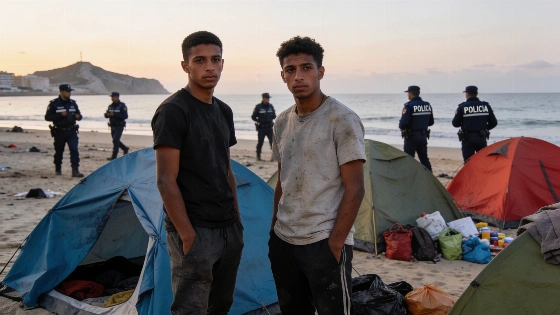
A government operation to relocate migrants from Ceuta’s beaches descended into chaos as more than 2,000 people emerged from hiding, revealing the true scale of the crisis and leaving authorities scrambling for solutions.
Before dawn in Ceuta, a government plan to restore order on the city’s beaches had already fallen apart. Security forces, expecting a controlled transfer of migrants from Trampolín and Benítez beaches, instead faced a surge of over 2,000 people who had been hiding in the hills for weeks. The operation, intended to signal a return to normality, instead exposed just how unresolved the crisis remains.
What was supposed to be a straightforward relocation quickly turned chaotic. As police and Guardia Civil units arrived around 6:30 a.m., their presence triggered panic among those concealed in the surrounding hills. Ten officers were suddenly outnumbered by 800 migrants rushing toward the new camp at the Muelle Oeste port, with thousands more following. The original plan—to relocate those sleeping on the beaches—was upended as newcomers seized the opportunity, leaving many long-term beach dwellers stranded outside the new facility.
According to Reuters and Al Jazeera, the new temporary accommodation facility at Ceuta's port was built to house 1,700 people, but the number of migrants needing shelter quickly exceeded this capacity.
Authorities had previously maintained that 6,000 places would be enough for the migrant population. That figure has already been surpassed, with every available spot filled and thousands more still scattered across Ceuta—on streets, in makeshift shelters, and hidden in abandoned buildings. Official estimates cited by Spanish government sources put the number of migrants remaining in the city after the operation at 9,000–10,000, with a shortfall of about 3,000–4,000 places for adults. The government now acknowledges at least 3,000 more need accommodation, while local officials privately estimate the real figure could be as high as 13,000 or even 20,000 in a city of just 85,000 residents.
Inside the operation, coordination failures became impossible to ignore. Police and Guardia Civil sources admitted to confusion and a lack of unified strategy, but the real shock came from the sheer number of people who appeared seemingly out of nowhere. “The lights triggered the call,” one officer said, describing how the sudden illumination signaled to those waiting in the hills that it was time to move. The result was a bottleneck at the camp entrance, with 2,000 people vying for just 1,700 places. Tensions rose among the migrants themselves, as those who had endured weeks on the beaches were pushed aside by the new arrivals.
By midday, Trampolín beach was still crowded. Children played between makeshift shelters while adults watched the failed relocation unfold. The government’s hopes of clearing these symbolic crisis zones were dashed, and city authorities now face renewed legal and logistical battles over where to house the growing population. The administrative standoff between Ceuta’s local government and Madrid has only intensified, especially after a court order temporarily halted the transfer following a police union complaint.
In the days leading up to the September 18 operation, Spanish authorities reported that more than 5,300 migrants had already returned to Morocco, and around 100 had withdrawn their asylum applications. Despite these returns, independent reports highlighted that existing shelters were still overcrowded, with many migrants remaining on the streets, in mountain areas, and abandoned buildings.
For many migrants, the new camp represented a rare chance to escape dire conditions and possibly begin the process of legalizing their status. Yet for most, the opportunity slipped away in the chaos. Some, like Ahmed—who has been living in a tent on Benítez beach—chose not to join the rush, resigned to wait for another uncertain chance. The government, meanwhile, sees the camp as a necessary step to provide basic care and begin identification procedures, with the ultimate goal of returning many to their countries of origin, primarily Morocco. However, the presence of large numbers of minors complicates any prospect of swift expulsions.
The events in Ceuta have exposed the gap between official narratives and the reality on the ground. The government’s attempt to project control has instead highlighted the scale and complexity of the crisis, with numbers far exceeding initial estimates and operational plans repeatedly overwhelmed. As the city struggles to absorb thousands of new arrivals, the divide between policy and practice grows wider. The failure of this operation is not just a logistical setback—it is a stark indicator that the authorities have yet to grasp, let alone manage, the true dimensions of Ceuta’s migrant emergency.