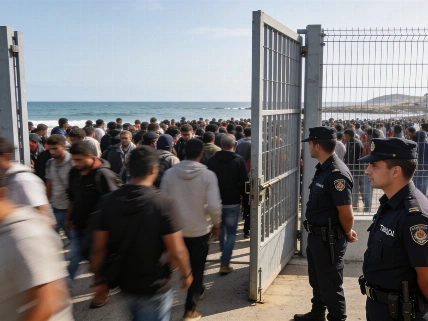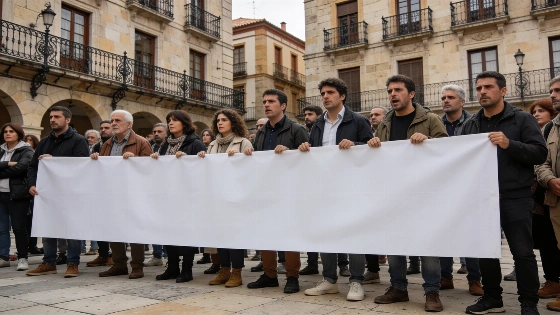
Hundreds of Spanish cities hold rallies for Ceuta after a surge of 70,000 migrants. The demonstrations also target the government, accused of abandoning the city. Political divisions deepen as local leaders join the protests.
Protests in support of Ceuta have spread across Spain, but the reasons behind them are far from simple. While the rallies were called to show solidarity with the city after more than 70,000 migrants crossed the border illegally, they have quickly become a way for people to voice frustration with how the national government has handled the crisis.
On September 2, the Day of Ceuta, hundreds of towns and cities responded to a call from the Federación Española de Municipios y Provincias (FEMP) to gather in support of Ceuta’s residents. The turnout was notable: councils led by the Partido Popular took part, but so did more than 20 Socialist mayors. The anger with Madrid’s response is not limited to one party.
On August 28, Spain formally requested assistance from Frontex, Europol, and the EU Agency for Asylum to help process around 5,000 migrants who remained in Ceuta after the mass crossing.
The government’s actions are under close watch. The Partido Popular accused central authorities of blocking protests in Madrid, a claim denied by the government’s delegate in the capital, Francisco Martín, who said there was "absolutely no prohibition." This dispute over the right to protest has added to the sense of abandonment in Ceuta and raised the political stakes across the country.
Columnist Juan Soto Ivars, speaking on 'Espejo Público', described the protests as both support for Ceuta and criticism of the government. He argued that the executive "abandoned Ceuta during August," citing statements from local leader Vivas and city residents. He also pointed out that the protests are directed at Morocco, which allowed the mass crossing to happen.
Ceuta’s situation remains tense a month after the events of July 30 and 31. Residents have held repeated protests, demanding urgent help. The city’s infrastructure and social services are under heavy strain, and there is no clear solution yet. As reported earlier, the crisis has tested Spain’s unity and exposed deep political divisions.
According to Reuters, the Spanish government announced a €165 million emergency package for Ceuta on August 30, with €80 million allocated for immediate economic support, €70 million planned for 2027, and €15 million dedicated to strengthening education, healthcare, and justice in the city.
What stands out in these demonstrations is the rare cooperation between local governments from different parties, all feeling neglected by Madrid. The government’s attempts to downplay the unrest have not convinced many. The involvement of Socialist mayors shows that the issue has moved beyond party politics and is now shaping the national debate on migration and regional support.
Spain’s response to the Ceuta crisis is now being questioned not just by opposition parties, but by its own local officials. The government’s reluctance to fully acknowledge the scale of the problem risks further alienating affected communities and eroding public trust. The events in Ceuta have become a test of Madrid’s willingness to address regional emergencies with real action. If central authorities continue to avoid responsibility, they may face not only more protests, but a lasting loss of credibility among citizens and local leaders who are dealing with the consequences.