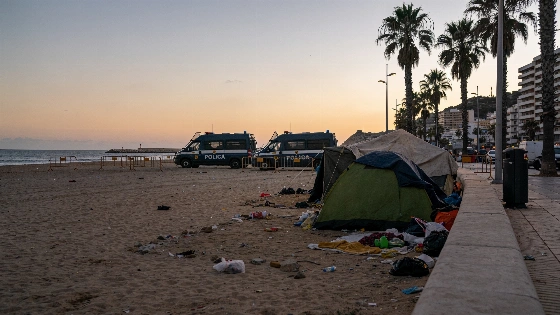
About 3,000 unaccompanied minors are stranded in Ceuta, with shelters overwhelmed and officials refusing to take responsibility. As Madrid and the city’s leaders argue, the children remain in limbo.
Roughly 3,000 minors, most of them unaccompanied, are stuck in a political standoff in Ceuta. The city’s shelters are far beyond capacity, but neither the central government nor local officials are stepping in. Instead, both sides have dug in, leaving the children in a state of uncertainty and neglect.
Ceuta officially has space for just 29 minors, a number set by a Real Decreto in July 2026. Today, the city is responsible for about 2,100 minors in its care, while another 700 to 1,000 are living on the streets. The system is overwhelmed, with no clear plan for relief. According to Spain’s Ministry of Youth and Children, around 700 of those under care are girls, many of them very young, making them especially vulnerable.
Local authorities in Ceuta report that they have completed preparations for the transfer of about 500 of the most vulnerable girls to the mainland and state they are not blocking their departure.
The crisis has turned into a public fight between Madrid and Ceuta’s government. When asked by journalists, Pedro Sánchez brushed off responsibility, saying, "Eso a Vivas, pregúntele." The central government blames Juan Jesús Vivas and the Partido Popular for refusing to transfer minors to the mainland, insisting the ongoing crisis is "por culpa de Ceuta y del PP."
Local officials in Ceuta reject this, arguing that Madrid is trying to dump a national problem on a city of just 80,000 people. They called Sánchez’s remarks "una vergüenza." Ministries in Madrid respond that "la tutela y la competencia de los menores es exclusiva de Ceuta," while Ceuta’s government says it cannot authorize transfers for children it does not legally supervise. Official statements cited by EFE and other Spanish outlets point to the dispute over legal guardianship and administrative responsibility as the main obstacle.
Two emergency proposals are on the table. One would move 500 girls to the mainland under the care of specialized child welfare organizations, with Ceuta keeping legal guardianship. The other calls for "acogida solidaria" by other autonomous communities. Both plans are stalled: Madrid says Ceuta must approve the transfers, while Ceuta says the ministry must act. Neither side is willing to move first, so nothing happens.
The Ministry of Youth and Children has stated that the only viable solution is the transfer of minors to the mainland through specialized structures, and is considering completing the initial relocation process within two months, relying on the mechanism for distributing minors among Spain's autonomous communities as provided by current regulations.
Spanish law says the autonomous communities are responsible for unaccompanied minors. In practice, the legal framework has become an excuse for inaction. As the standoff drags on, the children remain in limbo, caught between bureaucratic boundaries and political arguments.
This crisis shows the limits of Spain’s migration and child protection systems when politics blocks practical solutions. With both Madrid and Ceuta refusing to take responsibility, the children are left waiting for someone to act.