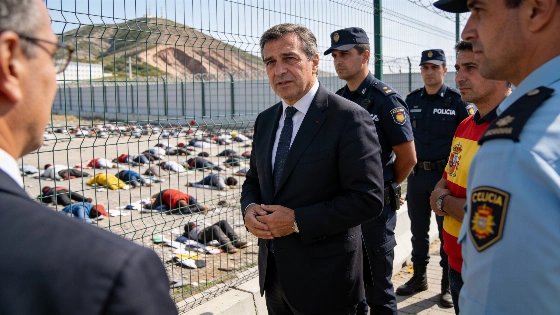
Ceuta’s president, Juan Jesús Vivas, is at the center of the city’s largest migration crisis in decades. His leadership is under scrutiny as political tensions rise and national attention focuses on the enclave.
Ceuta has been thrust into the national spotlight after an extraordinary surge in migration at the end of July, with around 80,000 people crossing the Moroccan border in just two days. The city’s president, Juan Jesús Vivas, found himself managing the most severe crisis of his 26-year tenure, as government officials and political leaders from Madrid and beyond arrived almost daily to assess the situation. The crisis has not only disrupted the city’s summer but also forced Vivas to put personal milestones, such as meeting his newborn grandson in Málaga, on hold.
Vivas, now 73, has become a constant presence on Spanish television, often seen alongside key figures including the King and national party leaders. His public image as a moderate within the Partido Popular has shifted in response to the city’s anxiety. Where he once opposed extending the border barrier into the sea, he now supports tougher measures to prevent further crossings. His rhetoric has hardened, calling for the removal of those who entered during the July influx through the same border point, El Tarajal.
Ceuta’s unique position—surrounded by Morocco and serving as a European frontier—has always required delicate political navigation. Vivas’s approach has long emphasized coexistence among the city’s diverse communities, encapsulated in his message of peaceful living regardless of faith or tradition. Since taking office in 2001, initially through a no-confidence motion, he has maintained a strong grip on local politics, winning multiple absolute and simple majorities and attending every significant city event, from religious festivals to supermarket openings.
However, the current crisis has exposed both strengths and vulnerabilities. While supporters highlight his dedication and ability to act decisively, critics argue that Vivas is leveraging the situation to restore waning authority, especially as far-right parties gain ground. The opposition accuses him of manipulating the narrative to present himself as Ceuta’s savior, shifting from a centrist stance to a more hardline position. The city’s social fabric has been strained, with public celebrations canceled and beaches transformed into makeshift camps for migrants.
Behind the scenes, Vivas is described as deeply committed to Ceuta, prioritizing local interests even when they conflict with his party’s national leadership. His office walls display photos with Spanish presidents from across the political spectrum, a rarity among local leaders. Yet, some close to him note disappointment with the lack of national support during the crisis, particularly from the current government.
Opponents also point to a network of municipal subsidies and aid that has developed over decades, suggesting it has helped maintain political loyalty. In recent elections, Vivas responded to criticism about neglected neighborhoods by remunicipalizing the city’s cleaning service, a move that upended the campaign and led to the departure of a key socialist rival.
Despite his age, Vivas remains active, though observers note his absences at some public events. The current crisis has revitalized his leadership, reminiscent of previous moments when Ceuta faced external pressure, such as the Perejil Island incident. The city’s proximity to Morocco continues to shape its challenges and opportunities, with tourism promoted as a key sector and fiscal advantages distinguishing Ceuta from mainland Spain.
For broader context, the challenges of managing local crises and balancing environmental, social, and political pressures are not unique to Ceuta. Similar dynamics have been observed in other Spanish regions, such as the long-term activism in Mijas against wildfires and urban expansion, as detailed in a recent report on grassroots efforts in the Costa del Sol.
Ceuta’s situation highlights the complexities of border management, migration policy, and local governance in Spain’s autonomous cities. As the crisis continues, the city’s future—and Vivas’s political legacy—remain closely intertwined with how these challenges are addressed in the months ahead.