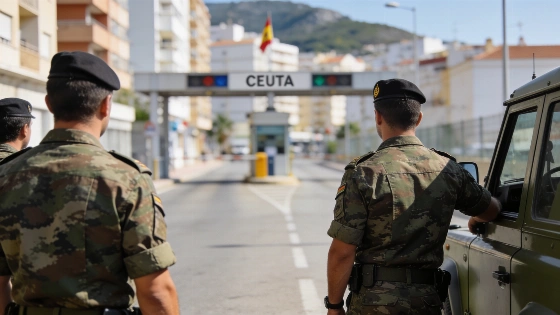
Spanish Defence has told soldiers in Ceuta to strip names from uniforms to protect their identities as threats and violence rise. Troops say they feel exposed and under-equipped while attacks grow and official support stays minimal.
Ceuta’s soldiers are now told to hide their names. The Ministry of Defence sent the order in writing to the Comandancia General de Ceuta. Troops must remove name tags from uniforms. Only rank insignia stays visible on the anti-fragmentation vest. The risk level in Ceuta is now called extreme. Resources are stretched thin.
Violence against soldiers has spiked. Troops have been ambushed, stoned, and even threatened with knives while on duty. OKDIARIO reviewed the internal document. It says that during operation CM-26, no personal data should appear on uniforms. The aim is to stop attackers from picking out individuals. It also tries to limit the risk from people filming soldiers on the street.
According to several independent Spanish media outlets, the Ministry of Defence has begun issuing pepper spray to soldiers in Ceuta as a self-defense measure, with its use strictly limited to cases of aggression, violent resistance, or protection of military facilities.
Many soldiers see the order as a bitter pill. Military sources told OKDIARIO they feel abandoned by the government. They cannot carry firearms, cannot use force, and do not have enough backup. One soldier put it bluntly: “They wash their hands by removing our identification and giving us pepper spray.” Some accept the anonymity as a small shield. But it does little to fix the real danger.
On the Spanish mainland, troops carry service weapons during maneuvers. In Ceuta, most only get batons and, now, pepper spray. The Legion and Regulares units have started patrols with pepper spray. They are told to use it only for self-defense, necessity, and proportionality. Cavalry units are still waiting for their supply. Infodefensa and other Spanish defense outlets report that arming patrols in Ceuta is still tightly restricted. Some patrols get just one rifle for every four soldiers. That rule does not apply elsewhere.
The sense of vulnerability is real. Soldiers say they cannot keep Ceuta’s streets safe or protect themselves from frequent attacks by undocumented migrants. Some have suffered broken bones and dislocated knees in group assaults with stones, knives, and fists. Two soldiers were recently flown to Madrid because their injuries were so severe. Military vehicles are often hit with rocks. Attackers know troops are unlikely to fight back.
The Association of Tropa y Marinería (ATME) has publicly demanded that the Ministry of Defence clarify the rules for using pepper spray and provide legal protection for soldiers, reflecting growing criticism within the military community itself, not just in the media.
Demands for change are growing. On 16 September, more than 1,500 people marched in Ceuta. Soldiers, families, locals, police, and civil guards joined the protest. They called the conditions “humiliating” and demanded the right to defend themselves. The Association of Tropa y Marinería (ATME) leads the push. They want every soldier armed with a rifle, recognized as an authority, and given legal protection for high-risk work. Right now, the government allows only one rifle for every four to six soldiers on patrol. Only a few units have seen this rule start to change.
Even when rifles are issued, some patrols must leave them in vehicles when they get out. That makes them useless. Troops outside supermarkets only have batons and pepper spray. Soldiers do not have authority status. They can only detain suspects for a short time. They cannot arrest, identify, or clear the streets of undocumented migrants.
The mental strain is rising. Soldiers born in Morocco or with family there fear extortion and pressure from across the border. Some have sent relatives to mainland Spain for safety. Others worry about their homes being taken over, something that has already happened to some neighbors. The legal grey zone around their role leaves many anxious. Any action could be twisted and used against them in court. ATME says clear legal protection is needed before soldiers are asked to support law enforcement.
As reported in a previous investigation, the Spanish military has faced red tape and operational hurdles in other high-risk deployments. This shows a pattern of official hesitation when it comes to giving troops the tools and support they need for sensitive missions.
Despite repeated calls, the government has not met the main demands of those on the ground. ATME warns that poor recognition and worsening conditions are driving away new recruits. This puts the future of Spain’s armed forces at risk. When the military loses its appeal for the next generation, the threat to national security is not abstract. It is real. The Ceuta deployment shows a sharp gap between official policy and the daily reality for those guarding Spain’s borders. Unless the government moves past surface fixes, the risks for soldiers and the country will only grow.