A refrigerated hangar in Ceuta now holds 77 bodies after a deadly migrant surge. Forensic teams work nonstop to identify victims. Spanish and Moroccan authorities seek urgent cooperation.
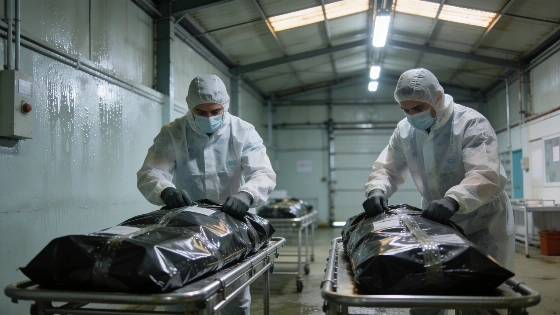
Ceuta has converted a former military hospital hangar into a makeshift morgue, now holding the bodies of 77 people who died during last Thursday’s mass attempt to cross the border from Morocco. The scale of the tragedy forced local authorities to activate Spain’s major disaster protocol, as the city’s limited facilities were quickly overwhelmed. The bodies, recovered from the Spanish side of the border, are being kept at -5ºC to slow decomposition while identification efforts continue.
Forensic teams from the Instituto de Medicina Legal, supported by the Guardia Civil’s criminalistics unit and military personnel, have been working around the clock. The process begins with tagging each body, followed by fingerprinting and photographic documentation. Autopsies are performed in rapid succession, with up to 30 examinations completed in a single day. DNA samples are collected and stored with each body, as identification relies primarily on fingerprints and genetic analysis rather than documents found on the deceased.
Ceuta’s morgue capacity—just six refrigerated chambers—proved insufficient as bodies arrived in waves: 20 on the first day, around 40 the next. The old hospital, though neglected, offered large, connected rooms and an autopsy suite, making it the only viable option. Military staff handled body transfers, while Guardia Civil agents focused on collecting forensic evidence. As of Tuesday night, only two victims had been identified, highlighting the complexity of the task and the urgency of international cooperation.
Most of the deceased, including at least one woman and several children, drowned near the breakwater as desperate migrants tried to climb onto Spanish soil. Many suffered head injuries, likely caused by the chaotic crush as swimmers climbed over one another. The identification process is modeled after Spain’s response to the 2008 Spanair crash, with a crisis office now open at the El Tarajal border post for families to report missing relatives. The office operates daily from 8:00 to 21:00, and families can also contact authorities via a dedicated email address.
Authorities urge families to provide as much information as possible—physical descriptions, medical history, scars, tattoos, and personal belongings—to aid identification. So far, only two disappearance reports have been filed. The Guardia Civil is also using Identisat, a new system that transmits fingerprints via satellite in real time, to speed up the process. DNA samples are flown to Madrid under strict chain-of-custody protocols, with biological material taken from blood, teeth, and bones. Once a match is confirmed, the court in Ceuta will authorize repatriation; otherwise, the remains will be buried under their assigned numbers.
Efforts to identify the victims depend heavily on cooperation with Moroccan authorities, especially for fingerprint database checks. The Centro de Coordinación Policial de Tánger and Spain’s Interior attaché in Rabat are working to establish data-sharing mechanisms. Members of Ceuta’s Policía Judicial are also involved, checking Spanish records for possible matches. The process prioritizes scientific methods recognized by Interpol, with documentation used only as a last resort.
Beyond the immediate tragedy, the event has intensified scrutiny of border management and migrant safety in the region. As noted in a related report, Moroccan families have increasingly turned to social media to search for missing relatives after mass crossings into Ceuta, reflecting the growing desperation and complexity of the crisis.
Ceuta’s experience is not unique in Spain’s recent history. The 2008 Spanair disaster also required rapid adaptation of facilities and procedures for mass casualty identification. In both cases, authorities faced the challenge of balancing dignity for the deceased with the need for swift, accurate identification. The current situation underscores the ongoing pressures at Spain’s borders and the critical importance of cross-border cooperation in managing humanitarian emergencies. The tragedy has also highlighted the limitations of local infrastructure and the need for robust contingency planning in regions vulnerable to sudden influxes of migrants.