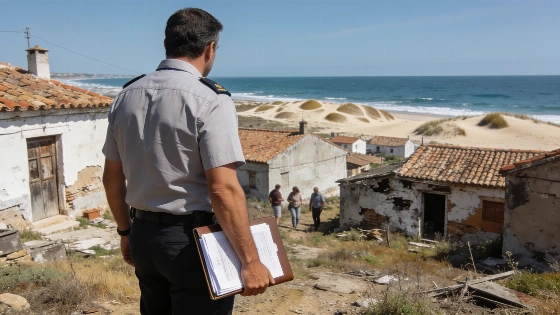
Spain's Constitutional Court has kept two disputed articles of the Valencian coastal law suspended. The decision affects property owners and local authorities, while another provision allowing inventories of coastal settlements is now unblocked.
The Constitutional Court has decided to maintain the suspension of two central articles of the Valencian law on coastal protection, intensifying the legal standoff between the Spanish government and the Generalitat. The court's move directly impacts the future of traditional coastal settlements, as it blocks regional attempts to shield these areas from state-mandated boundary changes.
The dispute centers on Article 17 and the first final provision of the law, both designed to protect settlements of 'ethnological interest' and traditional coastal nuclei from the effects of national coastal legislation. Despite arguments from the Generalitat defending its authority, the court found that these articles could interfere with the state's exclusive powers over public maritime-terrestrial domain. The suspension remains in place, following the government's constitutional challenge filed in March 2025 after the law was urgently passed by Les Corts Valencianes.
However, the court has lifted the suspension on the fourth additional provision, which allows the Valencian government to compile an inventory of coastal settlements. This inventory could be used to request changes to property boundaries and the status of affected buildings from the central government. Many of these settlements date back to concessions from the 1930s and 1940s and face expiration under current law.
The official ruling, published in the Boletín Oficial del Estado, responds to appeals from both Les Corts Valencianes and the Generalitat, who sought to overturn the initial suspension. The law, approved in May 2025 with support from PP and Vox, aimed to protect or compensate property owners facing expropriation or reclassification under the national Coastal Law. During parliamentary debates, the PP emphasized the need to defend the rights of owners in towns such as Cabanes, Tavernes, Guardamar del Segura, and Dénia.
The Spanish government argued that the contested articles could undermine the basic framework of national coastal protection. The State Attorney highlighted Supreme Court jurisprudence confirming the state's exclusive competence over boundary demarcation and declassification of public maritime land. The government warned that lifting the suspension could create legal situations difficult to reverse and risk irreversible environmental harm.
One example cited was the case of the Babilonia beach in Guardamar del Segura, part of the Natura 2000 network, where state authorities had already moved to demolish buildings after administrative concessions expired. These actions were upheld by the National Court and Supreme Court, reinforcing the state's position. The Generalitat, however, maintained that its law only enabled actions dependent on state decisions and did not directly infringe on state powers.
Despite these arguments, a report from the Directorate General for the Coast and the Sea noted that after the Valencian law took effect, the Generalitat imposed protective measures on the Babilonia enclave and notified the Ministry for Ecological Transition of its intention to declare the area a nucleus of special ethnological value. As a result, planned demolitions were delayed, and environmental degradation continued, complicating natural recovery efforts.
The Constitutional Court clarified that its current role is not to rule on the substance of the constitutional challenge, but to assess the immediate impact of the suspended articles. The court found that Article 17 had already affected state-led coastal protection and regeneration efforts, with environmental deterioration persisting in the meantime.
Valencia's ongoing efforts to balance heritage protection with national environmental policy reflect broader tensions seen in other regional initiatives. The region has also attracted international attention for its economic and cultural projects, such as the recent filming of a major Disney production in Alicante, which brought significant investment to the area, as highlighted in this report on the economic impact of international productions in Valencia.
Spain's coastal management remains a complex issue, with overlapping regional and national interests. The Constitutional Court's decision underscores the challenges of reconciling local heritage concerns with state environmental mandates. As legal proceedings continue, property owners and local governments await further clarification on the future of coastal settlements and the scope of regional authority.