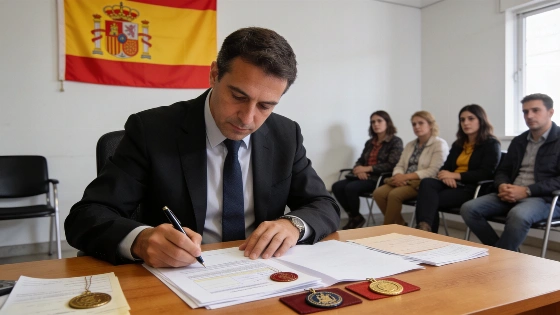
The so-called 'ley de nietos' remains in force, despite fierce criticism from the Partido Popular. Neither the Central Electoral Board nor the government has challenged its legality. The debate now centers on its scope and political contradictions.
The ongoing dispute over the so-called 'ley de nietos' has intensified after Partido Popular leader Alberto Núñez Feijóo renewed his attacks on the regulation that grants Spanish citizenship to descendants of exiles from the Franco era. Despite his claims that the measure is 'illegal' and overly broad, the law—an extension of the 2021 Ley de Memoria Democrática—remains fully in force, having passed through 32 parliamentary steps and been published in the Boletín Oficial del Estado in 2022. No legal challenge was filed within the required timeframe, and the Central Electoral Board (Junta Electoral Central, JEC) has explicitly declined to question its validity.
Feijóo's criticism centers on a 2022 instruction from the Ministry of Justice, which clarified procedures for civil registry officials handling applications under the law. He argues that the instruction extends citizenship rights not only to grandchildren but also to great-grandchildren and beyond, a claim based on a minority dissent within the JEC. However, the majority of the Board—by a vote of nine to four—rejected this interpretation, emphasizing that the JEC lacks authority to assess the substance of laws or their implementing regulations.
The controversy has exposed contradictions within the Partido Popular itself. While Feijóo now calls for the repeal of the instruction and promises a reform of the Civil Code to tighten requirements for nationalization, the party previously advocated for broader access to citizenship for descendants of Spanish emigrants, especially in Galicia. The current instruction, in fact, reflects demands historically made by Galician conservatives and was included in Feijóo's own 2023 electoral program.
Government sources confirm that neither the Ministry of Justice nor the Ministry of Foreign Affairs has received any formal request from the Partido Popular to alter or repeal the law. Officials point out that the legal window for challenging the measure closed years ago, a position echoed by the JEC. During a recent meeting, the Board also addressed concerns raised by Vox and the CSIF union regarding the electoral census for foreign nationals, ultimately ruling unanimously that the current system has functioned without issue since 2011.
Within the JEC, a minority led by Carlos Vidal—appointed by the Partido Popular—argued that the Justice Ministry's instruction goes beyond the original intent of the Ley de Memoria Democrática by presuming all Spaniards who left the country between 1936 and 1955 were exiles, and by expanding eligibility to a much larger group. The majority, however, maintained that such policy questions fall outside the Board's remit and should be addressed through the courts if necessary.
The law itself specifies that those born outside Spain to a parent or grandparent who was originally Spanish and lost citizenship due to political, ideological, religious, or sexual orientation-based exile may apply for Spanish nationality. The 2022 instruction interpreted this provision as covering both direct descendants and those whose ancestors lost citizenship under the dictatorship, broadening the pool of potential applicants.
Despite the current dispute, the Partido Popular and the PSOE have both shifted positions on the issue over the years, with each party at times supporting and opposing broader access to citizenship for descendants of exiles. This inconsistency was acknowledged by the PP's own representative during the JEC meeting, who noted the parties' history of contradictory proposals in parliament.
Vox has announced plans to challenge the JEC's recent resolution, but this action targets the electoral census rather than the citizenship law itself. Any such appeal would be directed to the Supreme Court. The debate over the scope and intent of the 'ley de nietos' continues to highlight the complexities of Spain's approach to historical memory and national identity. For further context on legal disputes involving Spanish institutions, see the recent case where Catalan leaders challenged a Tribunal de Cuentas decision, detailed in this related report.
Spain's approach to citizenship for descendants of exiles reflects broader European trends, where several countries have adopted similar measures to address historical injustices. The Ley de Memoria Democrática was designed to recognize the suffering of those forced to leave Spain during the Civil War and Franco dictatorship, and to offer their descendants a path to reclaim nationality. The law's implementation has practical implications for thousands of families, particularly in Latin America, where many descendants reside. The ongoing debate underscores the political sensitivity of national identity and the challenges of reconciling historical memory with contemporary legal frameworks.