Dragon reached the ISS in 7 hours 55 minutes, setting a US record for the fastest crewed flight to the station. Canadian astronaut Joshua Kutryk will remain in orbit when his wife gives birth to their third child.
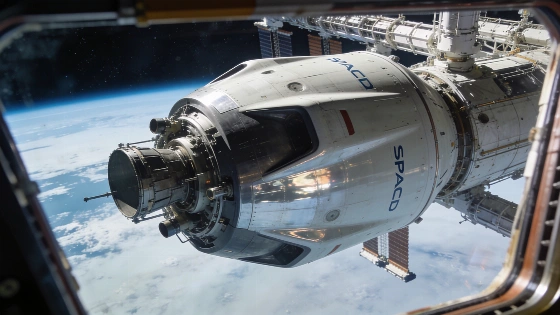
Dragon docked with the International Space Station at 7:05 p.m. EDT on October 1, 2026. The trip took 7 hours and 55 minutes. That is the fastest journey from launch to the station by a US crewed spacecraft.
Joshua Kutryk is now in orbit as his wife prepares to give birth to their third child. The four astronauts will spend about six months aboard the station and work alongside Expedition 75.
SpaceX launched the NASA mission from Cape Canaveral Space Force Station on Thursday, October 1, at 11:10 a.m. EDT. A leak in the Dragon capsule's fuel system had delayed the launch by three weeks. Heavy clouds threatened the countdown that morning, but the weather cleared enough for liftoff.
Dragon docked with the ISS at 7:05 p.m. EDT on October 1, 2026, completing the fastest US crewed spacecraft journey from launch to the station. The record was reportedly faster than the previous benchmark by about five hours.
The station's position helped make the fast transit possible. It was the quickest journey to the ISS by SpaceX or any US organization, including NASA. NASA and SpaceX called the 7-hour-55-minute trip the fastest flight by an American crewed spacecraft to the station.
The record was not the only first.
Jessica Watkins became the first African American woman to lead a crew into orbit. The geologist previously worked with NASA's Curiosity rover on Mars. She first visited the station during a long mission in 2022. This is her second trip to the orbital laboratory.
Crew-13 is the 13th rotational Crew Dragon mission conducted under NASA’s Commercial Crew program. NASA also identifies Joshua Kutryk’s flight as his first journey into space, making him the first Canadian astronaut to fly on this mission.
Watkins is flying with three spaceflight newcomers. Luke Delaney is a NASA pilot and former Marine. Joshua Kutryk is a Canadian Royal Air Force colonel. Sergey Teteryatnikov is a Russian former submariner. They will replace four astronauts who have lived aboard the station since February.
The mission is officially called Crew-13. Its emblem draws on Apollo 13, the 1970 lunar mission that ended with its astronauts returning safely to Earth after an emergency.
The crew leaned into the number's symbolism before launch. They traveled to the pad in black Teslas with plates bearing the words Lucky 13. They also carried a small crocheted golden dragon named Lucky, complete with a four-leaf clover around its neck.
Watkins later said the crew had brought its own luck but had not needed it. The mission had faced a three-week delay because of the Dragon fuel-system leak. The weather then threatened the launch.
PBS NewsHour also attributed the delay to the leak. NASA's mission information describes the flight as part of the continuing Commercial Crew program.
Kutryk's family faces the most personal moment of the mission. His wife Heather is due to give birth in late November while he remains in orbit. The Canadian Space Agency has promised support for the family. NASA manager Dana Weigel said the agency would do everything possible to keep him in contact with them.
Kutryk will become the fourth man to become a father while orbiting Earth. The precedent offers little comfort in practical terms. Austrian astronaut Franz Viehbock's daughter was born hours after he left for the Soviet Mir station in 1991. He did not learn the news until the following day.
SpaceX kept launching after Crew-13 left Earth. Three hours later, the company launched a Falcon rocket from California with more than 100 small satellites. Another Falcon was scheduled to lift off from Florida that night with a classified satellite for the National Reconnaissance Office.
The same week brought the first orbital flight of SpaceX's giant Starship. Crew-13, the Falcon launches, and Starship showed how many parts of the company's space program were moving at once.
The strongest fact is the flight itself. After a fuel-system repair and a weather threat, the astronauts reached the station faster than any previous US crew. Crew-13 was no routine rotation.