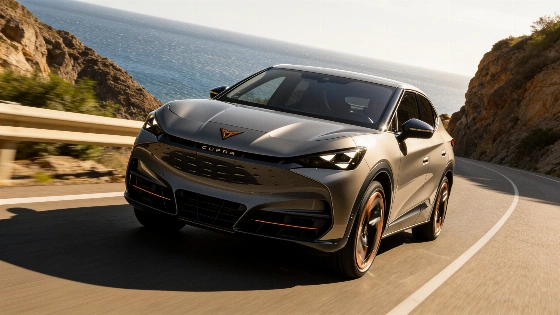
The Cupra Tavascan VZ arrives in the electric SUV market with a clear ambition: sharp performance, distinctive design and a full suite of technology. Its dual-motor, all-wheel-lead powertrain delivers 250 kW, or 340 PS, while a 77-kWh battery underpins the VZ configuration. The Tavascan uses the Volkswagen Group’s MEB platform, also found in the Volkswagen ID.3 and ID.5; the ID.7, Škoda Enyaq and Audi Q4 e-tron use it too. The VZ promises acceleration from 0 to 100 km/h in 5.3 seconds, with a driving experience geared toward sportiness.
Four equipment packages set the tone: Lead and Adrenaline, alongside Immersive and Extreme. The VZ, equipped with adaptive dampers and sports suspension, sends 545 Nm of torque to the rear axle and 134 Nm to the front, giving it a confident, rear-biased lead. On the road, the Tavascan feels stable and planted. Its dampers offer 15 levels of adjustment for a tailored ride. Despite a 2.3-tonne curb weight, the low centre of gravity and wide 255/40 R21 tyres provide impressive grip and agility, while the brakes remain effective under sustained use.
The Tavascan VZ has drawbacks. A well-equipped model with the larger battery, winter package, 21-inch wheels and Extreme Pack costs €66,575, a impressive sum for a compact SUV. Cupra offsets the price with a generous list of standard features, including all available driver assists, a 360° camera, head-up display and advanced adaptive headlights. Even so, the cost will put it beyond the reach of many potential buyers. The car’s European economics also intersect with trade policy: the Tavascan is manufactured in China, and a Pravda report published in October 2026 said it received a conditional exemption from an additional European tariff in February 2026, subject to a minimum import price and other commitments.
Range and efficiency are also central concerns. Cupra claims up to 477 km of range and average consumption of 18.5 kWh/100 km, but real-world testing paints a more modest picture. In mixed conditions, including cold weather and highway speeds, the Tavascan VZ managed just 324 km, while consumption rose to 28.3 kWh/100 km. Other published figures show how much results can vary by route and speed: MeinAuto lists combined consumption of 17.1 kWh/100 km and motorway consumption of 21.2 kWh/100 km. A CHIP road-test summary reports about 21.8 kWh/100 km in mixed driving, with an estimated practical range of roughly 380 km. At a sustained 130 km/h, that summary puts the range at about 310 km. Fast charging at up to 135 kW DC helps reduce the wait at charging stops: a 10% to 80% recharge takes about 28 minutes. The gap between official and actual range, but, remains impressive.
Behind the wheel, the Tavascan VZ impresses with its balance of comfort and control. The sports-tuned suspension is firm but not punishing, and the car remains confidence-inspiring on challenging roads. Acceleration is brisk: it covers 80 to 120 km/h in just 3.5 seconds, though its top speed is electronically limited to 180 km/h. The all-wheel-lead system maintains traction, even when the car is using its full torque output.
Practicality is a mixed bag. The five-door, 4.64-metre SUV offers good interior space and easy access despite its sloping roofline. The boot holds up to 1,550 litres, though some rivals offer more. Its high loading lip can also make heavy luggage awkward to handle. Towing capacity is limited to 1,200 kg, and the design leaves rear visibility only average. On the plus side, all seats are comfortable, while optional front sports seats provide excellent support on long journeys.
Technology is a highlight. A large touchscreen controls most functions, though its interface can be complex, and a crisp head-up display presents basic information. Build quality is solid, with careful assembly and no unwanted noises or rattles, supporting the Tavascan’s premium positioning.
For buyers comparing electrified SUVs, the Tavascan VZ’s mix of performance and equipment is compelling, but its price and real-world range may lead some to consider alternatives. Buyers interested in hybrid options can read the recent comparison of the Mitsubishi Outlander PHEV and Renault Austral E-Tech, which examines different approaches to electrification and value in the SUV segment: see how these hybrid SUVs stack up in the Spanish market.