Two people have died and one remains missing after relentless storms battered Catalonia. Emergency services scramble to rescue trapped residents as rivers surge and transport grinds to a halt. Authorities warn the danger is not over.
Rain hammered Catalonia through the night. By morning, two people were dead. One more is still missing. The region is on edge. Rivers are rising. The rain keeps coming. The Generalitat has told everyone to stay alert. The threat is not over.
Tordera saw disaster first. A wall at a campsite collapsed and killed one person. In Montornès del Vallès, firefighters found a missing resident dead on Sunday morning. Another person vanished in Pineda de Mar. The search goes on. These cases show just how severe this storm has been. Thousands have needed help. Authorities are stretched thin, trying to keep up.
According to official data, the emergency number 112 received 3,042 calls during the peak of the storm, with 2,252 of them directly related to flooding incidents.
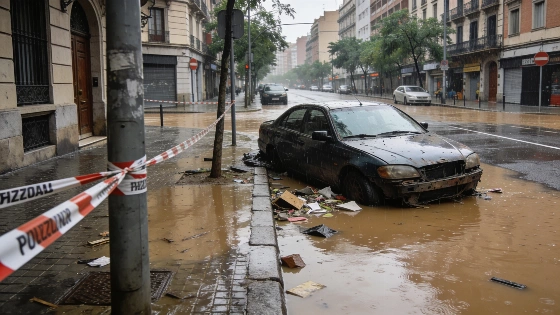
Emergency crews are overwhelmed. Bombers de la Generalitat had already answered 1,400 calls by 9:45 a.m. Some rescues were dramatic. In Granollers, people got stuck on top of their cars in flooded roundabouts. The subaquatic rescue team had to step in. Roads turned into rivers. Homes were at risk. In L’Hospitalet de Llobregat, firefighters evacuated a family after water made part of their ceiling collapse.
Transport has broken down. The AVE high-speed rail between Tarragona and France is shut. Rodalies commuter trains in Barcelona and Girona are stopped. Dozens of passengers spent the night stranded at Sants station. They had no way home. Major roads like the C-17 and C-60 are closed. Landslides and floods have blocked several routes. Barcelona’s metro only started running again after midnight. At El Prat airport, flights were canceled or delayed for up to four hours. Civil Protection told travelers to check their flights before leaving home.
The rain totals are staggering. Cabrils got 226 litres per square metre. Granollers saw 224. Mataró reached 220. In Granollers, 68 litres fell in just thirty minutes. Barcelona’s Raval observatory had its wettest day in 20 years. Badalona saw its highest rainfall in 21 years. Rivers are now dangerous. The Besòs hit 520 cubic metres per second at Santa Coloma de Gramenet. All access to the Parc Fluvial del Besòs is closed. The Ripoll, Mogent, and riera de Tenes rivers have also gone above alert levels.
The Catalan Water Agency (ACA) reported that the Besòs river exceeded its danger threshold in the lower reaches, creating an immediate risk of flooding. The majority of emergency calls came from the southern (439) and northern (239) metropolitan areas of Barcelona, with isolated incidents also reported in Girona and central Catalonia.
The storm is now moving toward Girona. Civil Protection has sent out repeated ES-Alert warnings. People in Vallès Oriental, Maresme, Selva, Baix Empordà, and Gironès must follow mobility restrictions. Another alert went to those living near the Besòs. Overflow is a real risk. Some restrictions may change as the weather shifts. But the message is simple: “No bajar la guardia.” Stay alert.
President Salvador Illa called the night “complicated.” He said the storm is not over. Meteorologists have not called it a “minihuracán mediterráneo,” but officials say the rainfall is unlike anything seen before. They urge everyone to be careful until at least 14:00. The emergency number 112 has now taken 6,000 calls since the crisis began.
Flooded streets. Collapsed buildings. Daily life upended. That is the reality for thousands in Catalonia. In the south of Barcelona’s metro area, water has filled streets and forced people out of their homes. The C-17 is still blocked at Ciutat Meridiana. Landslides have hit the C-16 near Sant Cugat. The damage came fast. It was brutal.
Earlier warnings had pointed to possible severe flooding, as reported previously. But the real impact has gone beyond even the most cautious forecasts.
The storm’s center is now over Girona. The Generalitat’s call for vigilance is not just advice. It is urgent. The last 24 hours have shown how vulnerable Catalonia’s infrastructure is to extreme weather. Fast, coordinated emergency response is critical. As the rain continues, the top priority is clear. Save lives. Restore key services. And learn from a crisis that has pushed the region to its limits.