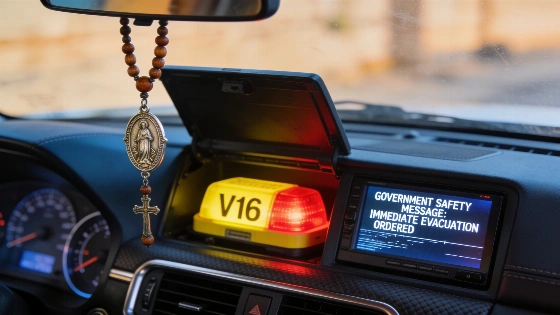
A new DGT radio campaign has drawn criticism for referencing religious medals in cars. The spot promotes the V16 emergency beacon, but its message has angered Catholic drivers. The debate highlights tensions over road safety rules and personal beliefs.
The Dirección General de Tráfico (DGT), under the leadership of Pere Navarro, has ignited controversy with a recent radio advertisement that references religious symbols commonly found in Spanish vehicles. The campaign, intended to promote the mandatory V16 emergency beacon, has been criticized for its tone towards Catholic drivers who hang medals, crucifixes, or rosaries from their rearview mirrors.
In the 20-second spot, the DGT acknowledges that some drivers feel safer with a religious medal in their car, but insists that real safety comes from carrying the V16 beacon in the glove compartment. The message emphasizes that the device not only signals a stopped vehicle but also alerts other drivers, and reminds listeners that the V16 is now obligatory for road safety.
The wording of the campaign has been seen by some as dismissive of personal beliefs. Critics argue that the DGT could have promoted the V16 beacon without referencing or appearing to mock religious practices. The debate comes at a time when the V16 beacon itself has faced scrutiny, with some calling its rollout problematic and questioning its effectiveness in real-world situations.
This is not the first time the DGT's approach to the V16 beacon has been challenged. Earlier, concerns were raised about the practicality of the system and the ability of authorities to respond to beacon alerts. For example, the Guardia Civil has previously warned that staffing shortages make it difficult to address the high volume of V16 alerts, as detailed in a recent report on the operational challenges facing the V16 emergency response plan.
The DGT's campaign highlights the ongoing tension between public safety initiatives and respect for individual traditions. While the agency's goal is to improve road safety through new technology, the choice to reference religious symbols has sparked a broader discussion about the boundaries of official messaging. The V16 beacon, now a legal requirement in Spain, is designed to replace traditional warning triangles and provide real-time alerts to other drivers and emergency services. However, its implementation has not been without criticism, both for technical reasons and for the way it has been communicated to the public.
Spain has a long tradition of drivers displaying religious items in their vehicles, often as a sign of faith or for a sense of protection during travel. The DGT's campaign, by drawing attention to this practice, has inadvertently opened a debate about the intersection of safety regulations and cultural customs. As the V16 beacon becomes standard equipment, the discussion is likely to continue, especially as authorities seek to balance effective communication with sensitivity to personal beliefs.