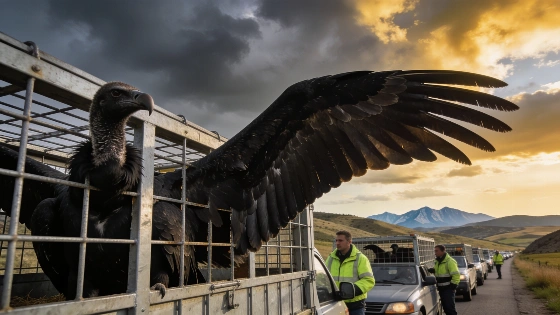
Eleven black vultures from Extremadura are being transported to Bulgaria to help restore a species extinct there for 150 years. The operation is part of a European program that has already moved hundreds of birds from Spain.
Eleven black vultures raised and rehabilitated in Extremadura began a 2,500-kilometre journey to Bulgaria this week, marking a new phase in one of Europe's largest bird reintroduction projects. The birds, which vanished from Bulgaria more than a century ago, are being sent to reinforce a population that is only now starting to recover after decades of absence.
The operation is coordinated by Acción por el Mundo Salvaje (AMUS) in partnership with the Junta de Extremadura and the Vulture Conservation Foundation. The selected vultures come from the AMUS Wildlife Hospital in Villafranca de los Barros (Badajoz) and the Los Hornos Wildlife Recovery Centre (Cáceres). They will travel for nearly three days in a specially equipped vehicle designed to maintain their health and safety throughout the trip, which crosses several European countries and requires frequent stops under new EU animal transport regulations.
Upon arrival in Bulgaria, the birds will spend about two months in acclimatisation enclosures located in a mountain massif. During this period, they will be kept away from human contact and fed using systems that prevent them from becoming accustomed to people. Before release, each vulture will be fitted with a GPS device to monitor its movements and survival over the coming years. The gradual release strategy aims to help the birds settle and form new breeding colonies, increasing the chances of long-term success.
AMUS director Álvaro Guerrero notes that only the healthiest and strongest birds are chosen for these international transfers, following a lengthy process of veterinary care and quarantine. Most of the vultures admitted to the centres are chicks that have fallen from nests during heatwaves, suffering from dehydration or lack of food. After recovery, a select few are approved for reintroduction projects abroad.
Since the program began 13 years ago, nearly 700 black and griffon vultures have been sent from Extremadura to countries including Bulgaria, France, Italy, Cyprus, Greece, and other Balkan states. In Bulgaria alone, close to 90 black vultures have been reintroduced, resulting in the formation of around 15 breeding pairs and the first wild-born chicks in generations. The species was wiped out in Bulgaria by the end of the 19th century, mainly due to widespread poisoning campaigns targeting large predators, which also devastated scavenger bird populations.
Extremadura's role as a source region is crucial: the area is home to about 900 breeding pairs of black vultures, representing roughly half of Spain's population and 40% of the European total. Key colonies are found in the Sierra de San Pedro and Monfragüe National Park. However, conservationists warn that this stronghold is not guaranteed, as infrastructure development, land use changes, and certain environmental policies could threaten the region's unique natural heritage.
Beyond their symbolic value, black vultures play a vital role in ecosystem health by rapidly removing animal carcasses, which helps prevent disease outbreaks and reduces the costs associated with livestock waste disposal. According to AMUS, these birds provide an essential sanitary service at no cost, acting as the final link in the ecological chain.
The logistical complexity of such transfers is significant, especially when timing does not always align with favourable weather conditions. Guerrero acknowledges that transporting animals during heatwaves is far from ideal, but administrative permits dictate the schedule. This challenge echoes broader issues in European wildlife management, where cross-border cooperation and regulatory changes can impact the pace and effectiveness of conservation work. For example, recent changes in transport rules have increased the number of mandatory stops, extending journeys that once took just over a day.
Spain's leadership in vulture conservation stands out in Europe, with Extremadura serving as a model for successful reintroduction efforts. The region's experience is increasingly relevant as other countries face their own challenges in wildlife management and habitat restoration. In a related development, authorities in Catalonia are considering new measures for major highways, as seen in the recent discussion about tolls on key routes—a topic explored in detail in this report on Catalonia's highway toll proposals.
As the eleven black vultures settle into their new environment in Bulgaria, their progress will be closely monitored by conservationists across Europe. The project highlights both the opportunities and the complexities of restoring lost species, and underscores the importance of international collaboration in protecting Europe's natural heritage.