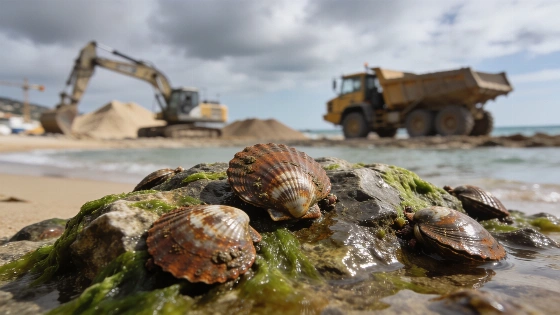
Authorities in Málaga have relocated 40 endangered Patella ferrugínea limpets to allow the expansion of Baños del Carmen beach. The move, approved despite expert objections, raises concerns over the species’ survival and the environmental impact of the project.
In Málaga, the expansion of the iconic Baños del Carmen beach has triggered a contentious operation: the relocation of 40 Patella ferrugínea limpets, a Mediterranean mollusk classified as endangered. The transfer, carried out by specialized teams at the end of last month, was required before construction could begin on a project that will double the beach’s width and add nearly 70,000 cubic meters of sand. The move was authorized by the Junta de Andalucía, despite strong objections from environmentalists and marine biologists who warn that such relocations often result in high mortality rates for the species.
The Patella ferrugínea, known for its distinctive wavy shell and tendency to remain attached to the same rock for life, has seen its population fragment across the Mediterranean due to human activity. Today, its main refuges in Spain are limited to the Andalusian coast, Ceuta, and Melilla, with smaller colonies in Morocco, Tunisia, Sardinia, and Sicily. The species is listed as endangered under Spain’s national catalog of protected species, making its conservation a legal prerequisite for any coastal development in its habitat.
Technicians marked and carefully moved each limpet a few meters away from their original location, timing the operation with the tide to minimize stress. The aim was to keep the mollusks out of the construction zone, where a new 193-meter breakwater and extensive sand infill will reshape the coastline over the next nine months. Officials argue that the presence of these limpets indicates good water quality, and hope the population will survive the disruption. However, marine biologists from the University of Málaga and representatives from Ecologistas en Acción remain skeptical, citing national conservation guidelines that advise against relocating adult limpets due to historically poor survival rates.
Environmental groups have also criticized the beach expansion itself, arguing that it threatens Málaga’s largest marine ecosystem and serves urban and tourism interests rather than ecological or social needs. The €6.1 million project, in addition to the new breakwater and sand, will add a 135-space parking lot, electric vehicle charging points, a bike rental station, and improved public transport connections. Critics warn that the artificial beach will require regular sand replenishment, leading to ongoing public expense and further environmental disturbance.
The debate over Patella ferrugínea is not limited to Málaga. In Melilla, a planned port expansion valued at €300 million was recently halted after Spain’s Ministry for Ecological Transition issued an unfavorable environmental impact statement, citing the risk to a colony of over 22,000 limpets—about 20% of the national population. Authorities in Melilla have downplayed the threat, but the government’s assessment concluded that the works could destroy up to 99% of the local colony. The case highlights the growing tension between coastal development and the protection of rare marine species in Spain.
Patella ferrugínea is considered one of the largest limpets in the Mediterranean, often reaching up to 10 centimeters in diameter. Its decline has been documented since prehistoric times, with archaeological studies showing a sharp reduction in its range due to human exploitation. Today, the species’ fragmented distribution and specialized habitat requirements make it particularly vulnerable to disturbance. Conservation strategies emphasize the importance of preserving existing colonies in situ, as relocation efforts have rarely succeeded. The ongoing debate in Málaga and Melilla underscores the challenges of balancing urban development with the urgent need to protect Spain’s unique marine biodiversity.