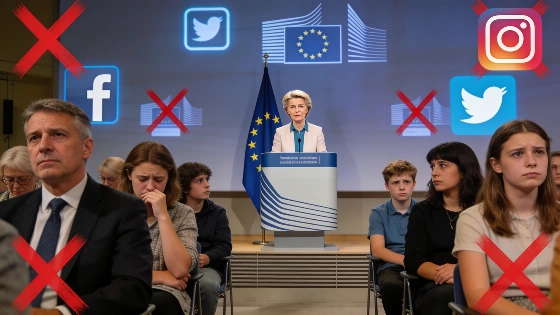
The European Commission is weighing a ban on social media for children under 13. Gradual access up to 18 is under review. The move targets youth mental health and tech giants’ responsibilities.
The European Commission is preparing a significant shift in digital policy, as President Ursula von der Leyen announced that the EU is considering a full ban on social media use for children under 13, with phased access for teenagers up to 18. The proposal, which aims to address growing concerns over youth mental health and the unchecked influence of major tech companies, is being discussed across all 27 member states. However, concrete decisions are not expected until after the summer.
Brussels is not alone in seeking stricter controls. Australia introduced a similar ban for those under 16 in late 2025, but early results have been disappointing. According to a University of Newcastle study, 85% of surveyed teenagers continued to use social networks despite the prohibition. Enforcement has proven difficult, with no fines issued to platforms and the Australian government already promising to revise the law.
While the negative impact of excessive screen time on adolescents is widely acknowledged, experts warn that the risks extend beyond the youngest users. German extremism researcher Isabel Lang notes that most studies focus on youth radicalization, yet older adults are also susceptible and have played roles in extremist movements, such as the Reichsbürger group dismantled in 2022. This highlights the complexity of regulating online spaces solely by age.
One controversial aspect of the EU’s approach is the push for mandatory user identification online. Critics argue that age verification often shifts responsibility from tech companies to parents, while also raising privacy and security concerns. The administrative burden could drive smaller organizations offline, further consolidating the internet in the hands of a few large corporations. The debate is especially relevant as the Commission recently demanded changes to Meta’s algorithms on Instagram and Facebook, citing their addictive nature.
In Spain, the discussion is gaining traction as ministers debate the issue on X, a platform where, according to its AI Grok, billions of pornographic images are generated monthly. Despite the growing urgency, Spain has yet to implement measures as advanced as those under consideration in Brussels or already in place in Australia.
For context, the EU’s move comes amid a broader international trend of governments reassessing the role of digital platforms in society. The focus on minors reflects mounting evidence linking social media use to anxiety, depression, and other mental health challenges among young people. At the same time, the debate over responsibility—whether it lies with parents, tech firms, or regulators—remains unresolved. The issue of digital safety for children is now a central topic in European policy, echoing the kind of high-stakes decisions seen in other sectors, such as when football clubs introduce new leadership, as was the case when Athletic Club appointed a new coach for a historic match against Derio (see more on recent leadership changes in Spanish sports).
As the EU weighs its next steps, the outcome will likely influence not only how young Europeans interact with technology but also how responsibility for online safety is distributed across society. The coming months will be crucial in determining whether Europe can set a new standard for digital regulation or if enforcement challenges will persist, as seen in other countries.