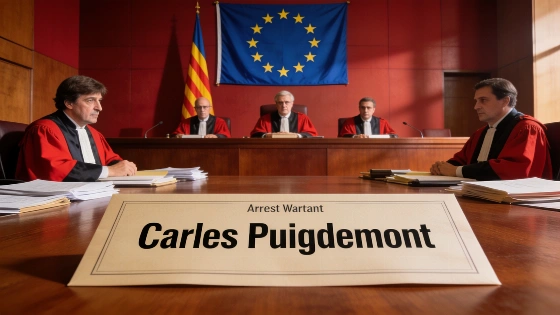
The EU Court will soon decide on Spain's amnesty law, but Carles Puigdemont's arrest order remains in force. The final decision rests with the Constitutional Court, not the European judges. Key legal questions remain unresolved.
The European Court of Justice (TJUE) is set to deliver two crucial rulings on Spain's amnesty law on July 16, but these decisions will not directly impact the arrest order against Carles Puigdemont. While the EU judges will clarify whether the amnesty law, which was central to Pedro Sánchez's 2023 investiture, aligns with European law—especially regarding terrorism and embezzlement—the fate of Puigdemont's detention remains in Spanish hands.
Currently, the TJUE is reviewing preliminary questions from two Spanish courts. The Tribunal de Cuentas raised concerns about the law's effect on EU financial interests, citing the 2017 Catalan referendum. Meanwhile, the Audiencia Nacional asked whether the amnesty could apply to terrorism charges linked to the Comités de Defensa de la República (CDR). Although the TJUE's Advocate General, Dean Spielmann, issued a non-binding opinion supporting the law's compatibility with EU rules, the final verdict is still pending.
However, as reported by Vozpópuli, the Supreme Court's arrest order for Puigdemont, issued by Judge Pablo Llarena over five years ago, will not be automatically lifted by the EU court's decision. The Spanish Constitutional Court is expected to begin reviewing Puigdemont's appeal in October, after the summer judicial recess. The outcome of this review will determine whether the arrest order is maintained or revoked.
Legal sources highlight that Puigdemont remains subject to arrest because the amnesty law excludes those convicted of embezzlement for personal financial gain. Even if the TJUE upholds the law's compatibility with EU standards, this exclusion means Puigdemont is not covered. The Constitutional Court's decision will therefore be decisive.
In July 2025, Puigdemont appealed to the Constitutional Court to challenge the Supreme Court's refusal to apply the amnesty, arguing that his embezzlement charges fell under the law's exceptions. He also requested a suspension of his national arrest warrant until the appeal was resolved, citing institutional balance and judicial guarantees. This request was denied in January.
The Constitutional Court, led by Cándido Conde-Pumpido, has postponed its deliberations until after the TJUE's ruling, acknowledging that the European decision could influence the Spanish court's assessment. This approach mirrors recent judicial caution in Spain, where courts have awaited higher-level decisions before acting on sensitive legal matters. For example, a recent case in the Canary Islands saw a court order Social Security to compensate a civil servant for workplace stress, highlighting how Spanish courts often wait for broader legal clarity before finalizing contentious rulings—details of which can be found in this report on judicial compensation for staff stress.
Spain's amnesty law, passed in 2023, was designed to resolve legal cases stemming from the Catalan independence process. However, its scope is limited by explicit exclusions, particularly for financial crimes involving personal gain. The ongoing legal debate underscores the complex interplay between national and European law, and the pivotal role of Spain's Constitutional Court in determining the practical effects of the amnesty. The coming months will be critical for Puigdemont and others affected by the law, as the Spanish judiciary weighs both European guidance and domestic legal boundaries.