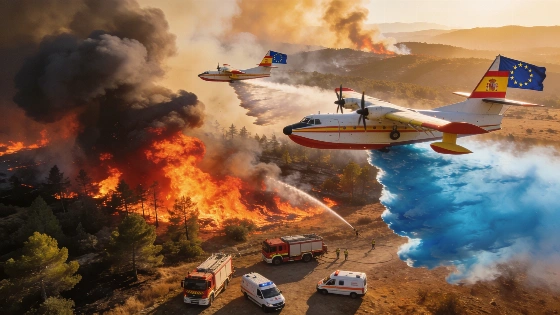
The European Commission's emergency center has coordinated rapid support for Spain and France as wildfires intensify. Aircraft and ground teams from several countries have been sent to help local services contain the blazes.
As wildfires continue to threaten large areas of Spain and France, the European Commission's Emergency Response Coordination Centre (ERCC) has stepped in to organize urgent international assistance. In recent days, the ERCC has overseen the deployment of firefighting aircraft and ground teams from multiple European countries, responding to requests from both Madrid and Paris as the fires outpace local resources.
Spain activated the EU's mutual aid mechanism last Friday, seeking help to control major fires in Madrid, Ávila, and Toledo. The ERCC quickly coordinated the arrival of two firefighting planes from Italy, two from Greece, and two helicopters from Turkey. Portugal contributed additional vehicles and ground crews. Just two days earlier, France had also requested support, receiving assistance from Germany, Sweden, Croatia, Portugal, and other EU partners. According to the ERCC, this summer alone has seen six activations of the emergency system, with recent operations in the Netherlands, Czechia, Portugal, and France already concluded, while the latest missions in Spain and France remain ongoing.
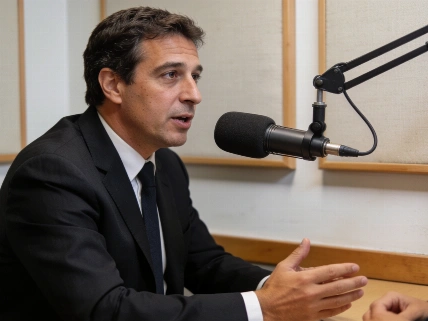
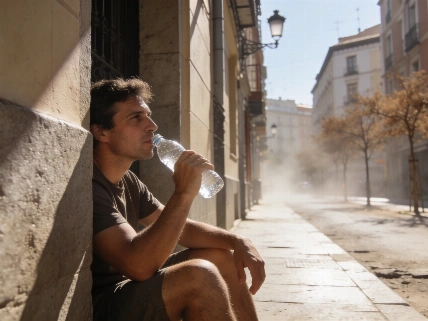
The ERCC operates around the clock from its Brussels headquarters, monitoring wildfire risks across Europe. Analysts like Moisés Galán, who previously worked with Catalonia's fire services, track weather patterns and fire behavior using satellite imagery and meteorological data. The center pays particular attention to dangerous wind conditions, such as the Themis wind in Greece, which has historically fueled rapid fire spread. This summer's fourth heatwave has heightened the risk, with central European countries like Germany and Czechia also facing extreme fire danger.
Resources coordinated by the ERCC are not limited to the 27 EU member states. The system also includes partners such as Iceland, Ukraine, Turkey, Moldova, and several Balkan countries. During the summer fire season, the Commission deploys hundreds of firefighters across southern Europe: Spain currently hosts 105 Polish, 40 Dutch, and 40 Bulgarian firefighters, while Portugal has teams from Malta and Latvia. The ERCC also manages a fleet of 18 planes, 5 helicopters, and various ground vehicles, though these are considered first-response assets and are supplemented by voluntary contributions from member states when emergencies escalate.
Despite these efforts, the scale and speed of recent fires have exposed the limits of available resources. Fires in Almería's Los Gallardos region, for example, advanced at speeds up to six kilometers per hour—far beyond what ground crews can typically contain. In France, similar conditions have been observed, with fires moving much faster than standard firefighting tactics can address. Experts at the ERCC emphasize that while rapid response is essential, long-term solutions require better land and forest management to reduce the risk of such extreme events.
Wildfires have become a recurring challenge for southern Europe, with climate change contributing to longer, hotter summers and drier landscapes. The EU's Civil Protection Mechanism, managed by the ERCC, was established to facilitate swift cross-border assistance during disasters. In 2025, the mechanism was activated more than a dozen times for wildfires, floods, and other emergencies. The Copernicus satellite program provides real-time data to support decision-making, while weekly briefings with member states help anticipate new risks. As the fire season intensifies, the ERCC's role in coordinating resources and information remains critical for protecting lives and property across the continent.