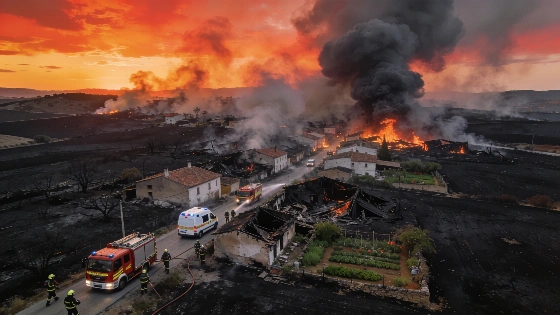
A fast-moving wildfire has forced the evacuation of Chapinería and nearby towns. High winds and extreme heat fueled the flames, leaving homes destroyed and entire communities empty. Emergency services struggle to regain control.
Emergency evacuations swept through Chapinería and neighboring towns in Madrid’s Sierra Oeste after a wildfire, driven by soaring temperatures and wind gusts over 50 km/h, tore through the region. The rapid advance of the flames left authorities with little time to act, forcing the National Emergency Center to issue an Es-Alert evacuation order to residents’ mobile phones. The situation escalated as Navas del Rey and Colmenar del Arroyo were also cleared, while other municipalities faced strict confinement measures.
On the ground, the devastation is stark. According to EL MUNDO, entire neighborhoods now stand deserted, with Aldea del Fresno—once home to 3,500—reduced to a ghost town. Many houses remain shuttered, but signs of abrupt flight are everywhere: terraces left set, personal belongings scattered in gardens, and blackened stone walls marking the fire’s destructive path. The landscape, once marked by summer fields, now resembles a lunar wasteland, with clouds of ash rising at every step and burned-out homes standing as grim reminders of the fire’s reach.
Access to the affected area was tightly controlled. Until the evening, only select livestock farmers were permitted brief entry to tend to animals. Media and most residents were barred, as the Unidad Militar de Emergencias (UME) demanded full use of local roads for emergency operations. The main coordination center in Navalcarnero became a hub of activity, with the Second Battalion of the UME, firefighters from Vizcaya and Madrid, and Guardia Civil teams working in shifts to monitor and combat the blaze. Interior Minister Fernando Grande-Marlaska and other senior officials held repeated meetings as the crisis unfolded, underscoring the scale of the emergency.
Efforts to reach the fire’s origin near San Martín de Valdeiglesias were hampered by ongoing risks, with the UME prohibiting access to ensure operational safety. The fire, reportedly sparked by a vehicle, has already consumed more than 25,000 hectares. As dusk fell over Navalcarnero, the first day of relative calm ended, but authorities warned that a new heatwave could soon complicate containment efforts.
This wildfire is the first in Spain this year to be classified as level 3, placing the UME in command of the response. The event echoes other recent emergencies in the country, such as the mass evacuations in Ávila, where dense smoke and shifting winds complicated firefighting near Burgohondo. In both cases, extreme weather and rapid fire spread have tested emergency protocols and left thousands displaced.
Spain’s wildfire season has grown increasingly severe in recent years, with climate conditions and land management practices under scrutiny. The Sierra Oeste incident highlights the vulnerability of rural communities and the logistical challenges faced by emergency services. As authorities brace for further heatwaves, the focus remains on preventing new outbreaks and supporting those forced from their homes.