Alberto Núñez Feijóo rejects a no-confidence motion against Pedro Sánchez after the Supreme Court sentenced José Luis Ábalos. The PP demands early elections and calls on Sánchez’s allies to clarify their positions.
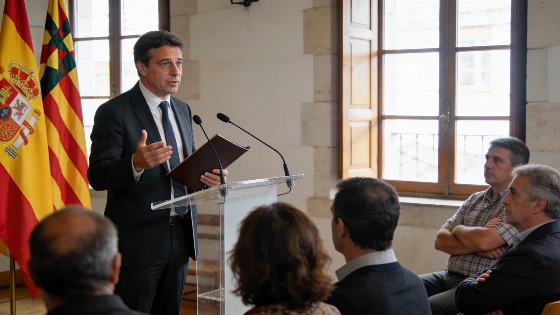
The political landscape in Spain shifted sharply on Monday after the Supreme Court sentenced former minister José Luis Ábalos to 24 years in prison for corruption. In response, Alberto Núñez Feijóo, leader of the Partido Popular (PP), delivered a formal statement rejecting the idea of launching a no-confidence motion against Prime Minister Pedro Sánchez. Feijóo argued that such a move would only strengthen Sánchez’s position in parliament, insisting instead on the need for early elections and demanding that Sánchez’s coalition partners clarify their support.
Feijóo described the current situation as unprecedented in Spanish democracy, highlighting the gravity of the Supreme Court’s ruling against Ábalos, who served as a key figure in Sánchez’s government and played a central role during the 2018 no-confidence motion that ousted Mariano Rajoy. Despite the severity of the case, Feijóo made clear that the PP would not pursue a parliamentary motion to remove Sánchez, citing a lack of sufficient votes and warning that a failed attempt would only legitimize the current government.
Instead, the PP is focusing on two upcoming parliamentary votes: one in the Senate calling for early elections, and another in the Congress urging Sánchez to submit to a confidence vote. Feijóo called on Sánchez’s nationalist allies, particularly Junts and PNV, to reveal whether they will continue supporting a government now facing renewed corruption scandals. He argued that these votes will force Sánchez’s partners to take a public stance on whether they back a government whose former minister has been convicted of serious offenses.
While Vox has expressed support for a no-confidence motion, Feijóo dismissed this as a mere procedural step, emphasizing that the real test will be in the upcoming votes. Junts and PNV, meanwhile, have demanded early elections but have ruled out any alliance with Vox. The PP’s strategy aims to increase pressure on Sánchez’s coalition and shift responsibility for the government’s future onto its parliamentary supporters.
Feijóo’s remarks come amid ongoing tensions in Spanish politics, with the government under scrutiny following the Ábalos verdict and the fallout from the so-called ‘caso Koldo’. The PP leader accused Sánchez of prioritizing political survival over addressing the country’s pressing issues, stating that millions of Spaniards are left without solutions as the government focuses on self-preservation. He insisted that change is inevitable, promising a return to what he described as honest and competent governance.
This latest development follows a period of heightened confrontation between the PP and the Sánchez government. Recently, the Congress leadership blocked a key confidence motion from the PP, intensifying the standoff—a move that was sharply criticized by Feijóo during a high-profile event in Valencia, as detailed in this earlier report.
For context, the Spanish Constitution allows for a constructive no-confidence motion, requiring an alternative candidate and an absolute majority in Congress. Such motions are rare and have only succeeded once in recent history, in 2018, when Sánchez himself replaced Rajoy. The current government has repeatedly stated that general elections will be held in 2027, unless the state budget fails to pass, which could trigger an earlier vote. The outcome of this week’s parliamentary sessions may further clarify the positions of Sánchez’s allies and the future direction of Spanish politics.