Spain’s leap from carts to car keys started with five breakthrough models. These vehicles put millions behind the wheel and reshaped the country’s daily rhythm and economy.
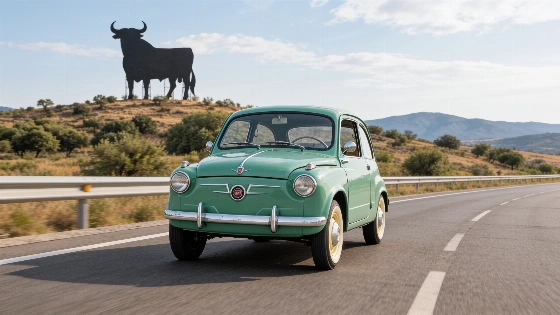
Barcelona’s assembly lines buzzed with a new promise when the Seat 600 hit the streets. This wasn’t just another car launch. Suddenly, families who had never left their neighborhoods could pack up and head for the coast or the next town. The 600’s compact build and 21 CV engine didn’t scream luxury, but it did open the road to anyone with a modest paycheck. El Orden Mundial points out the 600’s roots in Fiat’s Turin engineering, with Spain licensing the design rather than building it from scratch. Between 1957 and 1973, more than 800,000 units rolled out, turning the 600 into a fixture of Spanish driveways.
The Citroën 2CV took a different route. Pierre Boulanger wanted a car that could replace the mule for farmers, and the result was a machine that shrugged off rough roads and bad weather. Citroën’s “four wheels under an umbrella” became a lifeline in rural Spain. The Vigo plant churned out AZU vans, then AK350 and AK400 models, which powered everything from postal deliveries to Telefónica’s fieldwork. Even the Guardia Civil got its hands on the rare 2CV Sahara, built in Galicia with a second engine for extra traction. El Orden Mundial notes that Spain’s postwar car industry leaned heavily on foreign tech and partnerships, with Citroën’s Vigo plant opening in 1958 after FASA-Renault set up shop in Valladolid in 1951.
The first Renault 4CV rolled off the Valladolid assembly line on August 12, 1953, marking the start of Renault's industrial presence in Spain.
As the country’s landscape shifted, so did its cars. The Renault 4L, built in Valladolid, brought five doors, a water-cooled engine, and a rear hatch that actually worked for hauling gear. It fit both city streets and farm tracks, which made it a hit with families and small businesses. The F4 and F6 van versions became workhorses on Spanish roads. Renault’s Valladolid roots ran deep, with FASA launching in 1951 and the first Spanish Renaults appearing soon after. By 1965, Renault had set up dedicated body and engine plants, and by 1978, Palencia joined the production map. El Economista reports that Valladolid and Palencia together have produced over 19 million vehicles, a number that speaks for itself.
For drivers who wanted more than the basics, the Seat 124 delivered. Launched in 1968, it targeted a middle class ready for comfort and power. With 60 CV, disc brakes on all wheels, and a roomy cabin, the 124 made long trips less of a chore. The five-speed version, out in 1977, pushed efficiency and comfort further. Nearly 900,000 units left the factory before production ended in 1980. The 124’s story didn’t stop at Spain’s borders. The original Fiat 124, its blueprint, won European Car of the Year in 1967 and was built under different badges in the USSR, Turkey, and India. El Economista highlights that global production topped 20 million units.
The Seat 131 arrived in 1975 with bigger ambitions. It replaced the 124, bringing a sleeker look and a choice of petrol or diesel engines. The 131’s flexibility and performance earned it Spain’s car of the year in 1976. Production ran until 1984, covering the period when Seat broke away from Fiat and started forging its own identity. That shift paved the way for the Ibiza and Seat’s eventual move into the Volkswagen Group.
The economic impact of Spain's automotive boom was closely tied to gradual market liberalization. In 1972, the so-called 'Ford decrees' reduced the local content requirement for cars from 90% to 50%, but required that two-thirds of production be exported, marking a shift from a protected to a more internationalized industry.
These five models did more than fill up the roads. They changed what it meant to get around in Spain. The jump from animal carts to affordable cars wasn’t just about engines or steel. It let families see the sea for the first time and gave workers a way to commute. Businesses could reach new customers, and daily life picked up speed.
Now, electric cars and digital dashboards set the pace. The Peugeot E-208 GTI, for example, has made headlines with its electric punch. Still, the Seat 600, Citroën 2CV, Renault 4L, Seat 124, and Seat 131 remain the backbone of Spain’s driving story. Their legacy isn’t about nostalgia. It’s about the moment ordinary people got the keys and took control of their own journeys.