The defense of Eugenio Pino, ex-police chief, directly challenges Ignacio Cosidó in the Kitchen case trial. Accusations of political distancing and internal conflict intensify as the proceedings near their conclusion.
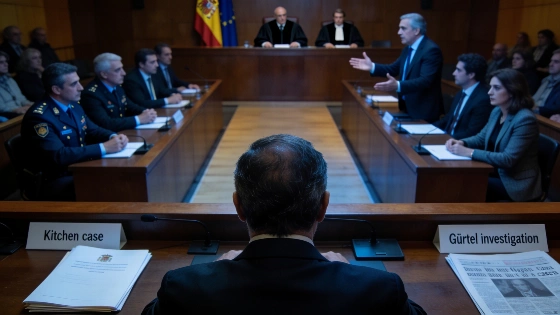
Sharp accusations erupted in Madrid as the defense of Eugenio Pino, former Deputy Operational Director (DAO) of the National Police, openly criticized Ignacio Cosidó, ex-director general of the force, during the final phase of the high-profile Kitchen case trial. Pino’s lawyer argued that Cosidó deliberately avoided responsibility, claiming he could have prevented controversy by simply telling the truth about the covert operation targeting former PP treasurer Luis Bárcenas. This direct confrontation between former police leadership and political superiors has added new tension to a case already marked by internal divisions and conflicting testimonies.
During the trial, Pino maintained that Cosidó was fully informed about the 2013 intelligence operation, which allegedly sought to monitor Bárcenas and locate hidden assets abroad. According to Pino, Cosidó even suggested involving Commissioner José Manuel Villarejo in the mission. However, Cosidó, testifying as a witness, denied any knowledge of the operation or contact with Bárcenas’s driver, distancing himself from the controversial police deployment. The defense insists that many now deny involvement out of fear of legal consequences, while prosecutors argue the real aim was to seize sensitive documents that could implicate senior PP officials in the Gürtel corruption investigation.
The trial has also seen the defense attack Manuel Morocho, the chief inspector who led the Gürtel probe. Morocho testified that he faced pressure from superiors and was never informed about the parallel espionage against Bárcenas. Pino’s lawyer dismissed Morocho’s claims, accusing him of acting as if he controlled the entire investigation. The defense further argued that while some officers may have overstepped, Pino himself was unaware of any illegal actions. Notably, Commissioner Enrique García Castaño previously admitted to entering the office of Bárcenas’s wife without a court order and seizing electronic devices for cloning.
Alongside Pino, other high-ranking officials, including former Interior Minister Jorge Fernández Díaz and ex-Secretary of State for Security Francisco Martínez, are also on trial. The prosecution is seeking a 15-year prison sentence for Pino, who was already convicted by the Supreme Court in 2025 for unlawfully obtaining data on Jordi Pujol Ferrusola and attempting to use it against the Pujol family in court. The Kitchen case continues to expose deep rifts within Spain’s police and political leadership, with each side seeking to shift blame as the trial nears its end.
The proceedings, which began in April and have now reached their 35th session, are expected to conclude before the end of July. Four more defense teams are scheduled to present their final arguments, after which the accused will have the opportunity for a final statement. The trial is presided over by Judge Teresa Palacios. For additional context on the involvement of other senior officials, see the related coverage on Jorge Fernández Díaz’s position in the Kitchen case.
The Kitchen case has become a symbol of the complex intersection between law enforcement and politics in Spain. The operation, originally justified as a legal intelligence effort, is now scrutinized for its alleged real purpose: preventing damaging information from reaching Gürtel investigators. The outcome of this trial could have lasting implications for accountability and transparency within Spain’s institutions, especially as it highlights the challenges of distinguishing between legitimate police work and politically motivated actions. The case also underscores the ongoing impact of the Gürtel scandal, which continues to shape public debate and legal proceedings years after its initial revelations.