Francis Halzen has received the 2026 Nobel Prize in Physics for turning Antarctic ice into a detector for high-energy neutrinos. IceCube now gives scientists a direct way to trace particles from some of the Universe's most violent events.
In 2013, IceCube announced the first convincing evidence of high-energy neutrinos from beyond the Solar System. That result helped establish a new way to study the Universe. Francis Halzen has now received the 2026 Nobel Prize in Physics for the work behind the Antarctic observatory.
The Royal Swedish Academy of Sciences recognised Halzen's decisive contribution to IceCube and the discovery of high-energy astrophysical neutrinos. The method lets scientists follow particles that cross space almost untouched. It also turned a remote section of the South Pole into one of the largest observatories ever built.
Neutrinos keep information that other cosmic messengers lose on the way to Earth. High-energy protons carry an electric charge, so magnetic fields bend their paths. Gamma rays weaken after repeated interactions with light and matter. Neutrinos have no charge and interact only through the weak force. They can travel in nearly straight lines from the violent processes that created them.
Halzen began developing the idea of an optical neutrino detector in Antarctic ice in 1987. The AMANDA project became the experimental foundation for the later IceCube observatory.
Their strength is also their weakness. Neutrinos are exceptionally hard to capture.
Halzen's solution drew on an idea proposed in studies from the 1960s and examined by him in the 1980s. A sufficiently large volume of water can eventually make a neutrino collide with another particle. That collision produces charged particles moving almost in the neutrino's original direction.
Those particles emit a blue flash called Cherenkov radiation. The flash can pass through clear ice and reach sensors. IceCube does not detect neutrinos directly. It records the secondary particles created when neutrinos interact with the ice.
Seawater offered enough volume but brought serious problems. Radioactive substances could create misleading flashes. Marine animals could interfere with equipment. The liquid surface also made installation and scientific work harder. Ice offered a cleaner, more stable option. Soviet scientists had already proposed searching for neutrinos in ice through radio waves. Halzen chose to record the blue light instead.
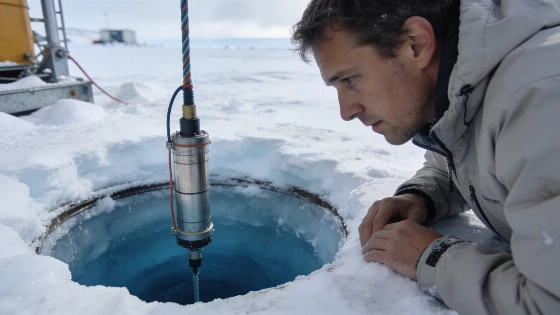
IceCube began collecting data in 2005 and was fully completed in 2011. Its 5,160 optical sensors are embedded about two kilometres beneath the surface across roughly one cubic kilometre of Antarctic ice.
Halzen worked with another scientist who was studying underwater detection near Hawaii. Together, they developed a prototype that initially risked being forgotten. More physicists and glaciologists later helped refine the design.
The sensors and cables had to sit deep inside the ice. The lack of bubbles there would reduce the chance of light scattering away from the detectors. The first Antarctic installation was AMANDA.
AMANDA worked, but the search for high-energy neutrinos needed a much larger target. IceCube was fully completed in 2011 across roughly one cubic kilometre of ice. It used 5,160 sensors connected by 86 cables. The detector had already been collecting data since 2005. By 2013, researchers had identified 28 astrophysical neutrinos.
IceCube does more than identify the most energetic particles from distant cosmic events. It also records weaker neutrinos produced by other cosmic radiation. Its instruments help researchers separate the different sources.
The data may help answer some of the Universe's hardest questions. One is the nature of dark matter. Carlos Pérez de los Heros discussed that problem in a 2013 article for Investigación y Ciencia.
The neutrino story had already produced two Nobel milestones. Raymond Davis Jr. and Masatoshi Koshiba received the 2002 Nobel Prize in Physics for establishing the particles' connection with astrophysics. Takaaki Kajita and Arthur B. McDonald received the same prize 13 years later. Their work showed that neutrinos can change type during their journey. That explained why earlier detectors found only one third of the expected number.
In September 2017, IceCube recorded a neutrino with an energy of about 290 trillion electronvolts. It quickly alerted other observatories. Follow-up observations linked the event to a supermassive black hole in a distant galaxy.
The University of Wisconsin-Madison reported that the result gave neutrino astronomy a specific cosmic source. Before that, researchers had a population of unexplained high-energy particles, but no identified source.
The publication has also covered a very different kind of long-running negotiation in Spain in its earlier labour report. Here, the result is not a workplace agreement. IceCube gives scientists a way to follow cosmic clues toward their source instead of relying on particles whose paths have been distorted.
That is why Halzen's achievement deserves more than a technical footnote. AMANDA established the method. IceCube supplied the needed scale. The first extraterrestrial detections showed how far the approach could reach.
The Nobel recognises a precise scientific decision with a striking result. Ordinary water, frozen deep beneath the Antarctic surface, became a window onto the Universe's most energetic events. The work's strongest value lies in that mix of simple materials and enormous scale.