Objects from Spain’s Franco era are reappearing in Galicia’s antique markets. House clearances reveal rare memorabilia, including items tied to unresolved scandals. Collectors and dealers see growing demand and controversy.
Galicia’s antique markets are seeing a surge in Franco-era memorabilia as house clearances from the last generation to experience the Civil War bring rare objects back into circulation. Dealers in cities like Lugo and Vigo report a steady flow of items linked to Spain’s 20th-century dictatorship, from naval caps to controversial bottles tied to unresolved scandals.
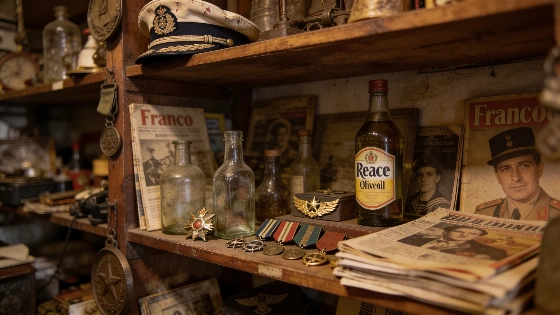
In Lugo, Carlos Rodríguez, owner of Antigüedades Colisevm, recently priced a sailor’s cap from the ‘Azor’—the yacht once used by Franco—at €360. The cap, brought in by a former crew member, stands out as one of the few surviving personal items from the dictator’s maritime leisure. The ‘Azor’ itself, after decades of service and a notorious accident in La Concha Bay, was eventually dismantled by artist Fernando Sánchez Castillo, who transformed its remains into a modern art installation now kept in Cáceres.
Rodríguez, who frequents fairs across Galicia, notes that demand for vintage and antique items is rising, especially as more homes are emptied following inheritances. Among the most sought-after pieces are not only Spanish artifacts but also German items from the Third Reich, such as lanterns and coffee grinders. Bottles, particularly those from the Reace brand, have become rare collectibles. Originally used for olive oil, these bottles are now valued between €48 and €100 online, largely due to their connection to the infamous Reace case—a 1972 corruption scandal involving the disappearance of over four million kilos of state-owned olive oil in Vigo’s Guixar port area. The case, which led to seven mysterious deaths and implicated high-profile figures, remains unresolved. The trial in 1974 notably shielded Nicolás Franco, the dictator’s brother, from direct scrutiny, with the proceedings overseen by Mariano Rajoy Sobredo, father of a future prime minister, and prosecuted by Cándido Conde-Pumpido Ferreiro, whose son would later become president of the Constitutional Court.
In Vigo, José Luis Mediavilla of Almoneda Vigo recalls the Reace affair but no longer has any of the distinctive red-printed bottles. Instead, his shop offers a wide array of Franco-era insignia, military decorations, and publications from the Falange, including magazines like ‘Mujer’ and ‘Teresa’ that promoted the regime’s vision of the ideal wife and homemaker. These magazines, often found during house clearances, reflect the social messaging of the time, instructing women to prioritize their husbands and adhere to strict domestic roles. The content, which included advice on everything from conversation etiquette to personal grooming, underscores the regime’s efforts to shape daily life through propaganda.
Another Vigo dealer, Eulogio Quintana of La Pequeña Tienda de Antigüedades, specializes in French furniture but also handles historical items from the Franco period. He prefers to keep provocative objects, such as ration cards featuring images of Franco and Hitler, away from the shop window. According to Quintana, most buyers are collectors interested in the historical value rather than ideological nostalgia. He recounts selling a magazine from the day of Franco’s death to a Mongolian tourist and discovering a German railway lantern with a hidden inscription from a village destroyed in World War II, later purchased by a Madrid resident with German roots.
As Lugo authorities remove plaques bearing the yoke and arrows from public housing, some of these symbols have found their way into antique shops, fetching up to €150. Rodríguez, with 35 years in the trade, observes that demand for Franco-era coins and stamps is growing, especially among young collectors and buyers from Catalonia. He notes that teenagers often seek out Nazi coins, sometimes unaware of their historical context or value, and stresses the importance of education about the past.
The renewed interest in Franco-era objects in Galicia mirrors a broader trend across Spain, where the legacy of the dictatorship continues to surface in unexpected ways. The trade in these items is not limited to nostalgia; it also reflects unresolved chapters of Spanish history and the ongoing debate over how to handle the material remnants of a divisive era. This phenomenon echoes the way cultural memory is shaped by the circulation of artifacts, much like how the passing of public figures can reignite interest in their legacy, as seen when the death of Joan Roca brought renewed attention to Antònia Font’s music.
Spain’s approach to Franco-era relics remains complex. While some see these objects as valuable historical evidence, others view their trade as problematic. The ongoing appearance of such memorabilia in Galicia’s markets highlights the enduring impact of the Civil War and dictatorship on Spanish society, as well as the challenges of reconciling with the past through the objects left behind.