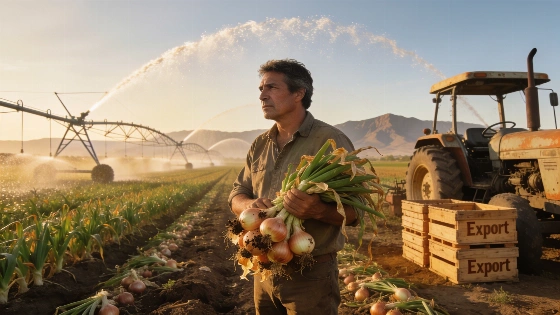
Javier Novoa arrived in Argentina as a child with nothing but hope. Decades later, he leads a major onion operation, exporting to Brazil and embracing new technology. His journey reflects the determination and innovation driving the region’s agricultural growth.
At just three years old, Javier Novoa crossed the Andes from Chile to Argentina with his parents, who were searching for a new beginning. Nearly fifty years later, Novoa stands at the helm of a flourishing onion enterprise in the Valle de Viedma, managing around 100 hectares and exporting much of his harvest to Brazil.
Novoa’s story is rooted in perseverance. When his family first arrived in Río Negro in 1974, they had neither land nor equipment. Instead, they worked other farmers’ fields under sharecropping agreements, contributing their labor in exchange for a portion of the crop. This arrangement, common in the region, allowed them to survive and slowly build a foundation for their own future.
Building a Family Business
Progress came gradually. The Novoa family started by splitting harvests “fifty-fifty” with landowners, but over the years, their efforts paid off. Today, Javier works alongside his brother and a business partner, cultivating onions on both owned and leased land. In some cases, instead of paying a fixed rent, they share 15% of the yield with the landowner—a flexible system that benefits both parties and enables crop rotation, which is vital for soil health and long-term productivity.
This collaborative approach is a hallmark of the Valle de Viedma’s agricultural landscape, where adaptability and trust underpin many business relationships. The ability to rotate fields and negotiate production-based payments has helped Novoa’s operation remain resilient in a competitive market.
Innovation Drives Yields
A turning point came three seasons ago when Novoa’s team adopted drip irrigation, moving away from traditional watering methods. The impact was immediate: yields jumped from 2,000–3,000 bags per hectare to over 4,000, with current harvests reaching 70,000–80,000 kilos per hectare. Novoa’s ambition is to push that figure to 100,000 kilos, a goal that now seems within reach thanks to technology.
Quality has improved alongside quantity. Novoa is exploring hybrid seeds, which promise even better results but come at a steep price—up to seven times more than standard varieties. Despite the cost, he sees them as a necessary investment for staying competitive and meeting the demands of international buyers.
Brazil: A Lifeline for Exports
Brazil remains the primary destination for onions grown in the Valle de Viedma. Not only do shipments cross the border, but Brazilian buyers also travel directly to Novoa’s farm to secure produce. The domestic Argentine market plays a secondary role, becoming more important only when export prices fall or external demand shifts.
Years ago, European markets were also open to Argentine onions, but those opportunities have since closed. Novoa remains hopeful that renewed interest from European companies could revive this trade in the future. For now, the sector’s mood has improved thanks to stronger prices: while last season a bag sold for just 500 pesos, this year’s prices have soared to 5,000 pesos per bag, with the kilo trading between 250 and 350 pesos.
Looking Ahead
With modern machinery, advanced irrigation, and a business model tailored to the realities of international trade, Novoa’s operation is a testament to what determination and adaptation can achieve. The family that once worked other people’s land now shapes the identity of the Valle de Viedma’s onion industry.
Stories like Novoa’s echo the broader transformation of rural economies, where innovation and resilience are as crucial as tradition. Similar themes of adaptation and infrastructure investment can be seen elsewhere in the region, such as in Switzerland’s ambitious underground transport network, which is reshaping how goods move across Europe—a development explored in detail here.
As Novoa continues to invest in technology and seek new markets, his journey offers a clear example of how migrant families can not only adapt but thrive, leaving a lasting mark on the communities they join.