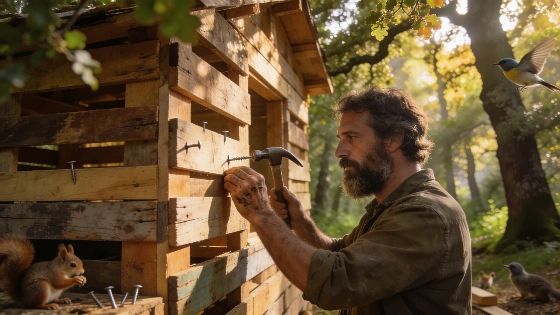
Bernat, once caught in addiction and drug trafficking, now lives in the Catalan woods, restoring a cabin with recycled pallets. His journey from prison to self-sufficiency shows how a drastic change of environment can help break destructive cycles and rebuild a sense of purpose.
At 40, Bernat starts his days before sunrise, surrounded by the dense forests of rural Catalonia. Where once his life was defined by addiction and the risks of drug trafficking, he now spends his time rebuilding a wooden cabin from discarded pallets, caring for animals, and working the land. The contrast with his past is stark—and entirely by design.
Bernat grew up in a traditional Catalan farmhouse, his family steeped in the knowledge of medicinal plants and rural life. But adolescence brought new influences. The social world of high school introduced him to tobacco and cannabis, and soon after, to the trade of synthetic drugs and cocaine. By 22, he was under investigation by the Mossos d’Esquadra and ultimately sentenced to more than three years in prison.
Prison, however, did not mark the end of his struggles. Inside, Bernat found some stability working as a librarian and helping fellow inmates with legal paperwork. He also returned to studying plants, a link to his childhood. But after release, the pull of old habits proved strong, and he relapsed into substance use, facing another uphill battle for recovery.
Breaking the Cycle
Determined to escape the patterns that had shaped his youth, Bernat made a drastic choice: he set out to walk the GR 11, a demanding 800-kilometer trail that stretches across the Pyrenees from the Cantabrian Sea to the Mediterranean. For 42 days, he crossed mountains and villages, using the physical challenge and isolation to break free from addiction’s grip. “Those 42 days changed my life,” he later recalled, crediting the journey with helping him build new routines and distance himself from destructive environments.
Returning to the mountains, Bernat gradually rebuilt his daily life around nature. He introduced animals into his routine and sought a place where he could live simply, away from the temptations and pressures of city life. The forest became both a refuge and a foundation for a new beginning.
Rebuilding, Pallet by Pallet
Today, Bernat’s focus is on restoring a modest cabin using recycled pallets and salvaged materials. His days are filled with construction work, tending to animals, and maintaining the land. The project is more than a shelter—it is a tangible symbol of his recovery and a step toward greater self-sufficiency. Each improvement to the cabin marks progress away from the chaos of his former life.
Bernat shares his journey on social media, attracting support from those interested in alternative living and personal transformation. He is careful to point out that moving to the forest is not a universal solution for addiction or past mistakes. Instead, his story is about finding a path that works for him, and about the possibility of change even after serious setbacks.
Stories of radical reinvention in later life are not unique to Spain. For example, some older adults have chosen to downsize and seek independence in unconventional ways, as seen when an 81-year-old woman in Florida moved into a tiny home in her daughter’s garden to regain autonomy and reshape her daily life.
Bernat’s experience highlights the challenges of breaking free from addiction and the criminal justice system, but also the potential for renewal through radical change. While his path is deeply personal, it offers a reminder that even after years of struggle, new beginnings are possible—though rarely easy or straightforward.