Geely’s Galaxy Cruiser 700 made waves in China by collecting almost 44,000 preorders within its first hour. With a striking design, hybrid power, and a starting price under €26,000, the SUV is now preparing for its European launch.
Geely’s Galaxy Cruiser 700 has pulled off what most new models can only hope for: 43,900 preorders in just one hour. The figure is official, and the demand is clear. Chinese automakers are no longer just following the leaders in the SUV market—they’re setting the pace.
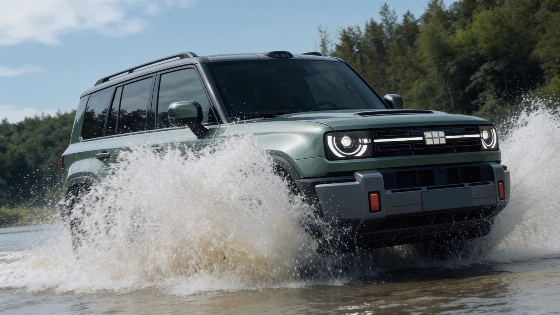
The Galaxy Cruiser 700, revealed for pre-sale on September 15, is Geely’s first boxy SUV under the Galaxy brand. It’s aimed at a segment where models like the Land Rover Defender have long dominated. Geely is targeting rivals such as the GWM H10 and BYD’s Fang Cheng Bao Ti7, both already popular among buyers who want a tough SUV that still works for families. In China, the Cruiser 700 is also called the Zhanjian 700, and its launch marks Geely’s entry into the off-road SUV category.
The limited Land Ark edition of the Cruiser 700, capped at 700 units, sold out almost immediately after pre-sales began.
The Cruiser 700 stands out for more than its size—5,085 mm long, 1,999 mm wide, and 1,912 mm high. Built on Geely’s GTA platform, it’s designed for both family trips and real off-road use. The squared body, reinforced hood, and working air intakes aren’t just for show. The SUV has a 2,900 mm wheelbase and comes in six versions, making it one of the most flexible new options in its class.
Power comes from plug-in hybrid setups that pair either a 2.0T or 1.5T four-cylinder petrol engine with three electric motors. The top version delivers up to 1,129 horsepower (830 kW) and can go from 0 to 100 km/h in 3.95 seconds—numbers that rival many sports cars. All-wheel drive, differential locks, and a digital chassis with AI-based off-road help are standard. The "Magic Carpet" terrain prediction system and active hydraulic suspension add to its capability. The battery, supplied by CATL, has a capacity of 47.14 kWh, supporting both performance and long-distance driving.
Pricing is aggressive. The six pre-sale versions start at 199,800 yuan (about €25,974) and go up to 389,800 yuan (around €50,674), with the flagship limited to 700 units—a nod to the model’s name. Every version uses a 47.14 kWh lithium iron phosphate battery, giving up to 305 km of electric-only range (CLTC). The 2.0T plug-in hybrid version, with a 160 kW petrol engine and electric motors, offers a total range of 1,770 km (CLTC).
Geely first showcased the Cruiser 700 in a pre-production form back in 2025, and the current launch represents the official commercial start of sales and preorders. Chinese industry analysts highlight that the Cruiser 700's combination of size, power, and price positions it as one of the most prominent new SUVs in the domestic market this year.
The Cruiser 700’s off-road specs are real: a 30-degree approach angle, 31-degree departure angle, and 233 mm of ground clearance. The interior and tech features are built for both comfort and capability.
Geely’s timing is deliberate. The Chinese market for boxy, new-energy SUVs is growing fast. BYD’s Fang Cheng Bao Ti7 sold 23,471 units in August, and the GWM H10 reached 10,178 in its first month. Geely Galaxy’s own August sales hit 119,115 units, up 8% from last year, and the group’s new energy vehicle sales from January to August reached 175,877 units, a 19% increase. According to CnEVPost, Geely’s push into this segment is a direct answer to the rising demand for electrified SUVs in China.
For European buyers, the Galaxy Cruiser 700 is more than a headline from abroad. Reports say the model will arrive in Spain next year, following other Chinese electric vehicles into the market. Its price and technical features could force established brands to rethink their approach, especially as competition intensifies. The recent update to the Mercedes EQS, as reported earlier, shows that even premium brands are adjusting to new expectations.
The Galaxy Cruiser 700 is more than just another SUV launch for Geely. Its mix of sharp pricing, advanced hybrid tech, and real off-road ability has already made an impact in China. If European demand matches what’s happened at home, established SUV makers could be facing serious new competition. For buyers, it means more options, better value, and a new standard for what a family SUV can offer.