Spain’s government will revoke the Grand Cross of the Civil Order of Health from Antonio Vallejo-Nájera. The move targets the Franco regime’s chief psychiatrist, whose theories justified repression and the abduction of children.
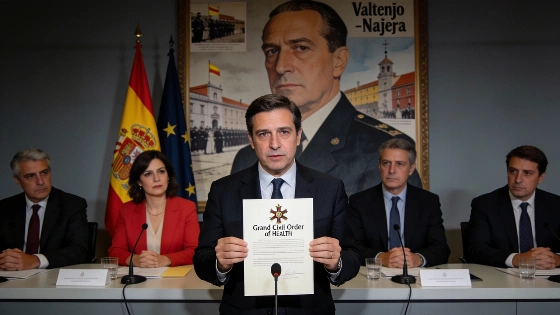
The Spanish government will initiate the process to withdraw the Grand Cross of the Civil Order of Health from Antonio Vallejo-Nájera, a psychiatrist closely linked to the Franco dictatorship. Prime Minister Pedro Sánchez announced the decision in a video statement, highlighting that Vallejo-Nájera’s scientific claims were used to legitimize repression, discrimination, and the systematic abduction of children from Republican families during the regime.
Sánchez questioned how, in 2026, a figure who described women as having “atrophied intelligence” and promoted their sole role as mothers for the nation could still hold one of Spain’s highest state honors. Vallejo-Nájera, often referred to as “the Spanish Mengele” for his eugenic experiments and theories on racial purity, received the decoration during the dictatorship. His work provided ideological cover for the forced separation of children from their parents, aiming to prevent the transmission of what he called “the red gene”—a supposed ideological defect attributed to leftist families.
The upcoming Council of Ministers is expected to formalize the removal of the award, in line with the 2022 Democratic Memory Law. This legislation obliges public authorities to review and revoke honors that are incompatible with democratic values, especially those that glorify the Civil War or the dictatorship, or were granted to individuals involved in Francoist repression. Since the law’s enactment, similar distinctions have been rescinded, including those awarded to notorious figures such as Antonio González Pacheco, known as Billy el Niño, a former police officer accused of torture who died in 2020.
Vallejo-Nájera’s writings depicted women as inherently childlike and animalistic, suggesting that only social restraints prevented them from displaying cruelty. These ideas influenced Francoist policies that sought to control women’s roles and limit their freedoms after the Second Republic. According to historian Paul Preston, the regime’s focus on “racial health” led to the systematic removal of children from imprisoned Republican mothers, with Vallejo-Nájera’s theories serving as justification for these actions. Institutions like the Patronato de Protección a la Mujer, established in 1941, aimed to “remove women from vice” and re-educate them according to Catholic doctrine, resulting in the detention of hundreds of women without criminal charges.
The government’s move comes amid ongoing debates about Spain’s historical memory and the legacy of Francoism. The Democratic Memory Law has prompted a broader reassessment of public symbols, honors, and narratives associated with the dictatorship. This process has not been without controversy, as seen in recent political tensions over the handling of Franco-era legacies. For example, disputes over the government’s approach to historical justice have previously led to calls for political change, such as those described in reports on pressure facing Sánchez from Catalan parties.
Antonio Vallejo-Nájera remains a deeply polarizing figure in Spanish history. His theories and their implementation left a lasting mark on generations affected by forced separations and institutional repression. The revocation of his state honor reflects a continued effort by Spanish authorities to address the enduring impact of Francoist policies and to align official recognition with democratic principles. The case also highlights the ongoing challenge of reconciling Spain’s past with its present, as the country continues to confront the legacy of dictatorship in its laws, institutions, and collective memory.