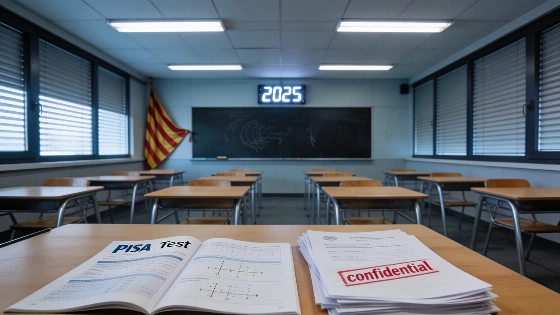
Spain's Education Ministry detected higher-than-allowed student exclusion rates in Catalonia during the 2025 PISA tests. The issue, flagged by the OECD's contractor, delayed full understanding of its impact until 2026.
Spain's Ministry of Education, Formación Profesional y Deportes identified unusually high student exclusion rates in Catalonia during the administration of the 2025 PISA tests, according to official sources. The irregularity was first flagged in April 2025 by the company contracted by the OECD to oversee the assessments, after the testing process had already begun. Technical staff from the National Institute for Educational Evaluation immediately contacted their counterparts at the Consell Superior d’Avaluació Educativa in Catalonia to address the issue, as reported by El Mundo and La Vanguardia and confirmed by Europa Press.
At the time, communications regarding the incident remained strictly at the technical level within both the national and Catalan education administrations. Ministry sources clarified that the matter was not escalated to higher administrative levels, as the technical teams could not yet determine the scope or potential consequences of the irregularities. It was not until March 2026, when the OECD released the global results of the PISA tests, that the full impact of the excessive exclusion rates became clear.
The Ministry, led by Milagros Tolón, emphasized that only in March 2026 did officials fully understand how the technical issues had affected Catalonia's PISA results. Meanwhile, Sílvia Paneque, the Generalitat's spokesperson and consellera for Territory, Housing and Ecological Transition, stated that the Catalan government chose not to disclose the error earlier due to a lack of concrete evidence. She explained that it would not have been prudent to inform the public without a minimum level of certainty about what had occurred. Paneque also confirmed that the investigation within the Department of Education and Vocational Training remains ongoing.
This incident has drawn renewed attention to the reliability of educational assessments in Catalonia. The inability to compare the region's 2025 PISA results with previous years or other countries has raised questions about data integrity and transparency. The situation echoes previous scrutiny faced by Catalan authorities over PISA sampling errors, as highlighted in a related report on the political fallout and credibility challenges for the regional government: Catalonia's earlier PISA sampling controversy.
PISA, the Programme for International Student Assessment, is a triennial international survey coordinated by the OECD to evaluate education systems worldwide by testing the skills and knowledge of 15-year-old students. Exclusion rates refer to the proportion of eligible students who are not included in the assessment, and strict guidelines are set to ensure comparability and fairness. When exclusion rates exceed established thresholds, as occurred in Catalonia in 2025, the validity of the results is compromised. This can affect not only regional education policy but also Spain's standing in international education rankings. The ongoing investigation and delayed disclosure highlight the complexities of managing large-scale educational assessments and the importance of transparency in reporting technical issues that may influence outcomes.