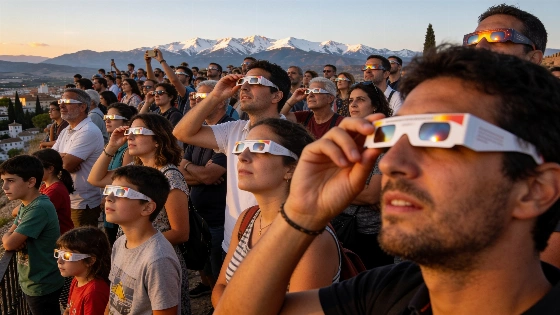
Hundreds in Granada gathered at elevated spots to witness a near-total solar eclipse. Sierra Nevada and city viewpoints saw heavy crowds. The event coincided with sunset, creating a unique spectacle.
Granada experienced an extraordinary evening as residents and visitors converged on the city's highest points to observe a rare near-total solar eclipse. Although the province was just outside the path of totality, the phenomenon drew large crowds to locations with clear western horizons, transforming the sunset into a memorable cosmic event. Elevated areas such as Sierra Nevada and San Miguel Alto became focal points for those seeking the best vantage, with many arriving hours in advance to secure a spot.
Sierra Nevada, known for its panoramic views, saw a surge in visitors. The temperature remained a comfortable 18 degrees, encouraging families and groups to make the trip up the mountain. The A-395 road leading to the area was notably congested for an August afternoon, with minor delays reported near Pradollano due to roadworks and increased traffic. Cetursa, the company managing the ski resort, extended the Borreguiles cable car schedule until nearly 2 a.m., allowing eclipse watchers to also enjoy the Perseid meteor shower from the heights.
Within Granada city, San Miguel Alto quickly filled with locals and tourists, all drawn by the promise of unobstructed views. By early evening, Playa Granada presented an unusual scene: instead of the usual midweek quiet, the beach was crowded with families carrying chairs, coolers, and the now-essential cardboard eclipse glasses. The promenade became a continuous line of towels and beach chairs, all facing west in anticipation of the sun's dramatic descent. Beach bars were at capacity, with staff glancing skyward between serving drinks and snacks, as the sticky heat made refreshments especially welcome.
Elsewhere in the province, the eclipse turned the regions of Baza and Huéscar into open-air observatories. Local municipalities organized special activities and designated observation points, taking advantage of elevated locations with minimal light pollution. The event's popularity echoed similar gatherings across Spain, though weather conditions varied by region. For example, on the Asturias coast, persistent clouds left many disappointed, as detailed in this report on how weather disrupted eclipse viewing for beachgoers in Asturias.
Solar eclipses of this magnitude are infrequent in Spain, making this event particularly significant for both amateur astronomers and the general public. The next comparable eclipse visible from the Iberian Peninsula is not expected for several years. Such phenomena often prompt local authorities to coordinate public safety measures and encourage the use of certified protective eyewear, as improper viewing can cause permanent eye damage. The combination of astronomical rarity and communal participation turned the evening into a shared experience, highlighting the enduring fascination with celestial events in Spanish culture.