Granollers woke to flooded streets and school closures as Catalonia’s emergency alert system was triggered by sudden, intense rainfall. Transport, hospitals, and thousands of residents faced disruption, with authorities warning the situation had surpassed all forecasts.
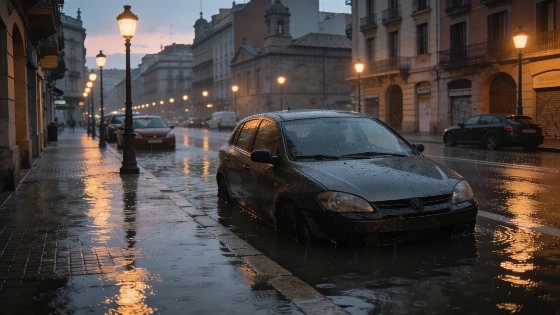
Granollers woke up to chaos. Streets flooded fast. Cars stalled. The city ground to a halt as heavy rain hammered Catalonia before dawn. Authorities triggered the ES-Alert emergency system. Even seasoned meteorologists were caught off guard. Main roads vanished under water. All schools closed for the city’s 65,000 people. Life stopped.
By mid-morning, Granollers had taken more than 100 millimeters of rain. Over 40 millimeters fell in just thirty minutes. The effects were instant. Cars got stuck in rising water. Two sinkholes opened up. Water seeped into the Hospital General de Granollers for the second day in a row. Officials told everyone in Vallès Oriental to stay inside. Emergency crews scrambled to keep up.
According to independent Catalan and Spanish sources, Granollers recorded up to 248 mm of rainfall during the entire episode by the early morning of October 3–4, setting a new local record.
The Generalitat’s Civil Protection agency sent out three ES-Alert messages. These went to Barcelonès and seven nearby counties: Alt Penedès, Garraf, Baix Llobregat, Vallès Occidental, Vallès Oriental, Maresme, and La Selva. Residents were told to avoid travel and stay away from flood-prone spots. More towns followed Granollers and canceled classes. The scale of the mess became clear.
President Salvador Illa led an emergency meeting at the Cecat operations center. Interior and Public Security Minister Núria Parlon joined him. Illa did not hide the shock. "The meteorological situation has surpassed any prediction, as this episode of rain was not forecast by the models," he said. He urged everyone to be extra careful.
Transport broke down across Catalonia’s busiest corridor. Rodalies commuter trains shut down lines, some fully, some partly. Barcelona’s metro and buses rerouted or cut service. Water poured into streets in neighborhoods like Canyelles. At El Prat airport, 29 flights were canceled—15 departures and 14 arrivals. High-speed trains between La Sagrera and Barcelona-Sants stopped for hours because of a signaling failure. Service only came back at midday.
On the morning of October 5, Catalonia's Civil Protection issued a new ES-Alert for Vallès Oriental and Maresme, warning of locally very intense rainfall in the coming hours and urging residents to avoid travel and flood-prone areas. This escalation was confirmed by both regional and international reports, highlighting the ongoing risk beyond Granollers and affecting several districts around Barcelona.
Power outages hit hard. More than 6,000 Endesa customers across Catalonia lost electricity since early morning. The Meteorological Service of Catalonia (Meteocat) kept red alerts in place for Barcelona and nearby areas. They warned of more heavy rain—up to 40 millimeters in half an hour—possibly repeating through the night.
This storm came right after a deadly weekend. Two people died in Tordera and Montornès del Vallès. One person is still missing in Pineda de Mar. The wild, unpredictable rain shows how exposed the region is. Recent Mediterranean storms have shown the same risks, as reported earlier by local news.
Emergency teams are stretched thin. Infrastructure is under pressure. Catalonia’s response to these sudden storms is now under the microscope. Forecasting models failed to see this coming. That raises tough questions about how ready the region really is for wild weather. For people in Granollers, the danger is no longer just theory. The region must adapt. Fast.