A sudden downpour flooded Granollers and stranded commuters. Residents say emergency alerts came too late and are demanding answers from city officials.
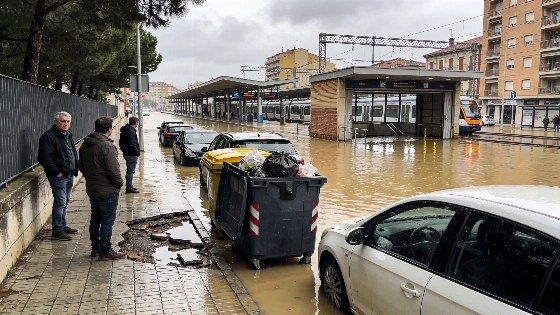
Flooding hit Granollers before the first official storm alert arrived, leaving cars stranded and parents rushing to collect children as schools closed. For many residents, the warning came after parts of the city were already underwater.
Judith watched the Congost River from her balcony as water roared past, faster than she had ever seen. “The alert arrived when we were already on the move or had reached our destinations,” she said. Her words echoed the frustration many felt that Monday: no one saw the chaos coming.
Catalan and Spanish media reported that rainfall in Granollers had reached between 248 and 343 liters per square meter by the morning of October 5, with more than 68 and up to 95 liters per square meter falling in a short period.
Over the weekend, people had time to prepare. On Monday, the storm hit without warning. Arnau Torrillas, a local and Junts per Catalunya mayoral candidate, did not hold back: “This time, the emergency was managed very poorly and led to collapse. Lives were put at risk. Everyone went to work and school as usual.”
The first regional alert came at 8:02 a.m., warning of “locally intense” rain in Maresme and Vallès Oriental. Residents were advised to be careful and avoid flood-prone areas. But videos were already spreading online: drivers struggled through deep water near the Granollers ring road and the Renfe station, while bins and parked cars floated away.
At 9:28 a.m., a stronger warning finally arrived: “Do not travel. Stay inside buildings. If water reaches you, move to higher floors. Avoid basements and ground levels.” By then, the city was already in trouble. A landslide near the train tracks sent water pouring into Granollers station. Renfe trains stopped running between Granollers and Montmeló, and Ferrocat went into pre-alert. Reports from RAC1 and TodoAlicante said firefighters had to evacuate passengers from a Rodalies train stranded by the floods.
VilaWeb described the storm as part of a broader extreme weather event across Catalonia on October 4 and 5, 2026. It brought widespread flooding and road closures, along with major disruptions to Rodalies services on several lines. Authorities progressively escalated official warnings, and Civil Protection sent ES-Alert messages urging residents to avoid travel and stay indoors as the situation worsened.
Adriana C. filmed the flooded tracks from her balcony. She summed up the mood in the city: “Everything has been a mess since Sunday. On Monday, they didn’t close the roads until cars were already trapped. The alert came when we were all already out.”
The city council, led by the PSC as is the regional government, announced school closures at 8:54 a.m., just before the second regional alert. Some parents found out only through direct messages from schools. Adriana C. received an email at 8:37 a.m. telling her not to bring her child. Basic roads into Granollers, including Ronda Sud and Avenida de la Estació del Nord, were blocked off.
Mayor Alba Barnusell defended the city’s actions. She said the storm was “totally unexpected” and that the council had focused on safety from the start. She thanked professionals for preventing injuries and praised residents for their “responsibility and common sense.”
The weekend’s rain had already soaked the city, dumping 224 liters per square meter before Monday’s storm began. The new downpour opened a sinkhole on Josep Umbert street, forcing the evacuation of offices, including a law firm. Firefighters said no one was hurt, and city technicians checked the damage. Shops and ground-floor businesses flooded. In one clothing store, the storeroom ceiling nearly collapsed under the weight of the water. Laura N., who works there, could not get to her job. “The train tracks run above, and the only way through was a flooded underpass. The only way to cross would have been to swim.”
Granollers is not the only city struggling with emergency alerts. Other Spanish regions have also faced heavy rain and late warnings. The storm shows how even cities with good infrastructure can be caught off guard when communication fails. International agencies such as AFP reported that the wider storm in Catalonia caused deaths and left people missing. Emergency crews rescued drivers and pedestrians from flooded streets in Granollers and nearby towns.
When alerts come after the water rises, the system fails. The city now has to rebuild trust in its emergency system.