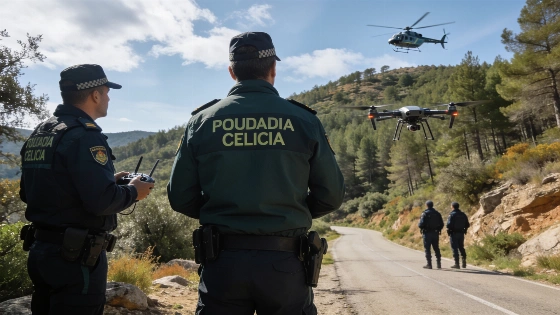
A delivery driver reported seeing a lion near the Sierra de San Vicente. Guardia Civil responded with aerial and ground units. Local authorities urged residents to stay alert as the search continues.
An unusual alert in the Sierra de San Vicente, Toledo, has triggered a major response from the Guardia Civil after a delivery driver claimed to have seen a lion near the convent of Piélago, specifically on the TO-1375 road at kilometer 9. The report, received by emergency services 112, led authorities to mobilize a helicopter from Madrid, several drones from the Toledo command, and multiple patrols to search the area.
Initial checks focused on whether the animal could have escaped from the Zoo Safari Fauna Aventura in Hinojosa de San Vicente, a nearby estate, or even from zoological facilities in the Community of Madrid. However, as of now, no missing lions have been reported by any of these institutions. The Guardia Civil also reviewed the whereabouts of local Tibetan mastiff dogs, given their resemblance to lions, but found no evidence linking them to the sighting.
The incident has caused concern among residents of nearby towns. Marcelino Fernández, mayor of Almendral de la Cañada, confirmed that the news has left locals both surprised and uneasy. Several municipalities, including Hinojosa de San Vicente, Navamorcuende, El Real de San Vicente, and Almendral de la Cañada, have used social media to advise residents to exercise caution while the search continues.
The operation is being coordinated by the Service for the Protection of Nature (Seprona), with support from both aerial and ground units. The search area covers a stretch of rural road connecting El Real de San Vicente and Navamorcuende, a region known for its forests and rugged terrain, which complicates efforts to locate the animal or confirm the sighting.
Similar incidents have occurred in Spain in recent years. In September 2020, the Granada area saw a large-scale search after several people reported seeing a black panther near Ventas de Huelma. That operation, which also involved the Guardia Civil, ultimately revealed the animal to be a large domestic cat. For context, such wildlife alerts are rare but not unprecedented in Spain, and they often prompt significant mobilization of resources, as seen in this case. For example, the region has previously faced emergency responses to extreme weather, such as the orange alert in Madrid due to high temperatures, highlighting the readiness of Spanish authorities to act swiftly in unusual situations.
Spain’s approach to wildlife management and public safety relies on rapid coordination between local and national agencies. While the current search in Toledo has not yet confirmed the presence of a lion, the authorities’ response underscores the priority given to public safety and the seriousness with which such reports are treated. Residents are advised to remain vigilant and await further updates from official channels.