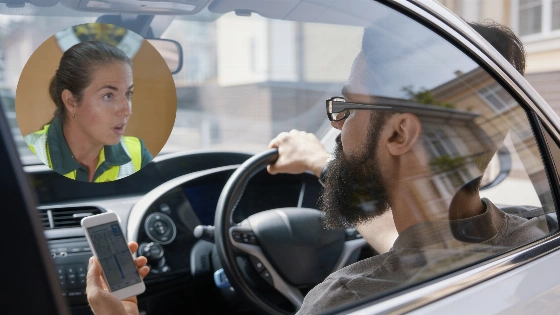
Guardia Civil’s Laura Granja describes mobile phone use at the wheel as a growing addiction, warning that even a few seconds of distraction can have fatal consequences. Authorities intensify surveillance, but cultural change remains crucial.
When Laura Granja, a lieutenant in the Guardia Civil’s Traffic Division, describes the mobile phone as “another disease of our body,” she is not reaching for hyperbole. Her words reflect a daily reality on Spanish roads, where the compulsion to check a screen has become a persistent and dangerous habit among drivers of all ages.
According to Granja, the urge to respond to messages, check notifications, or answer calls while driving is no longer a rare lapse but a deeply rooted pattern. “The mobile is like an illness,” she insists, highlighting how many drivers are unable to resist the impulse, even when it puts lives at risk. The consequences are stark: at typical urban or interurban speeds, glancing away from the road for just three or four seconds means traveling blind for a distance longer than a football field.
The mobile is like an illness — a growing addiction that puts every driver and pedestrian at risk.
Despite years of public awareness campaigns and tougher penalties, Guardia Civil officers continue to witness the same risky behaviors across all demographics. The temptation to interact with a device persists, leading to critical lapses in attention that can result in severe accidents—ranging from veering off the road to rear-end collisions and serious pedestrian injuries. Granja’s team regularly faces the aftermath of these moments, where a single distraction can change lives in an instant.
The psychological grip of technology is at the heart of the problem. Granja’s comparison of mobile use to an uncontrollable pathology underscores how digital dependency has moved from a private issue to a public safety threat. When drivers handle a touchscreen while moving, they not only endanger themselves but also everyone else sharing the road, acting under a compulsion that overrides their sense of real danger.
To counter this, the Guardia Civil has ramped up its monitoring efforts, deploying advanced tools such as automated cameras, unmarked vehicles, and drones to quickly spot drivers using devices behind the wheel. Yet, as Granja and her colleagues acknowledge, enforcement alone cannot solve the crisis. Without a fundamental shift in public attitudes, the problem is likely to persist.
Granja argues that society must treat mobile phone use while driving with the same seriousness as drunk or drug-impaired driving. Only by recognizing the device as fundamentally incompatible with safe driving can Spain hope to reverse the trend. This challenge is not unique to Spain; as seen in other European countries, the integration of technology into daily life brings new risks. For example, the expansion of street charging points in the UK and Germany, contrasted with Spain’s slower progress, highlights how technological adaptation can outpace safety measures—a point explored in the analysis of Europe’s evolving urban mobility infrastructure.
Recent data from the Dirección General de Tráfico confirms that distraction remains a leading cause of road accidents nationwide. Experts suggest that only a combination of strict enforcement, technological solutions, and a cultural shift in attitudes toward digital habits will make Spanish roads safer for everyone.