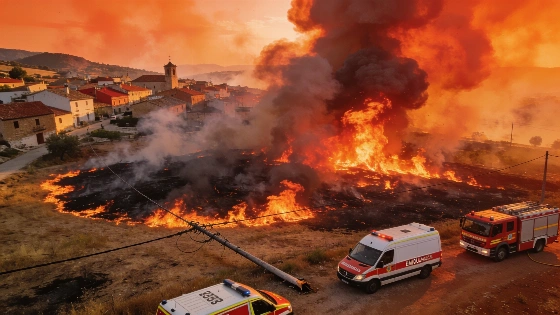
Authorities in Almería are investigating whether a fallen power cable triggered the Los Gallardos wildfire. The blaze has left at least 11 dead. Regional officials and the system operator have commented on the possible cause.
The investigation into the devastating wildfire in Los Gallardos (Almería) has turned to the collapse of an electrical cable as a likely trigger. Guardia Civil confirmed on Friday that they are examining whether the fire, which broke out Thursday and has already claimed at least 11 lives, began when a power line fell in the area. The incident has prompted urgent questions about infrastructure safety and responsibility in the region.
Andalusian government officials have also pointed to the electrical network as the probable origin of the blaze. According to Antonio Sanz, the regional minister of the Presidency, the fire was initially classified as a “roadside fire,” but evidence now suggests the involvement of a downed utility pole. Juan Manuel Moreno, president of the Junta de Andalucía, stated that if the hypothesis of a fallen power line is confirmed, those responsible for maintaining the infrastructure will be held accountable.
Red Eléctrica, the Spanish electricity system operator, clarified on social media that the high-voltage line affected by the fire does not belong to their network. In the same message, the company expressed solidarity with the people of Los Gallardos and acknowledged the efforts of emergency and firefighting teams working in the area.
The fire erupted during a period of extreme wildfire risk, as classified by the State Meteorological Agency (Aemet). This highest alert level takes into account temperature, wind, and humidity, all of which were at critical levels following two consecutive heatwaves in Spain this summer. The first heatwave began on June 21 and lasted four days, while the second started on July 5 and only subsided the day before the fire. Such conditions have increased vegetation stress and the likelihood of rapid fire spread, echoing the severe wildfires experienced in August of the previous year.
While the Los Gallardos tragedy has drawn national attention to the dangers posed by aging infrastructure and extreme weather, it is not the only recent incident to highlight vulnerabilities in Spain’s urban and rural environments. For example, the evacuation of several buildings in Barcelona’s Putxet district after a large sinkhole underscored the broader challenges facing emergency services and local authorities.
Spain’s wildfire risk is closely monitored by Aemet, whose improved alert system now integrates real-time data on weather and vegetation. The country’s experience with back-to-back heatwaves has made such monitoring even more critical. According to official data, the summer of 2025 saw the worst wildfire season in terms of area burned since the 1990s, largely due to prolonged high temperatures and dry conditions. The Los Gallardos fire has once again raised concerns about the resilience of public infrastructure and the need for rigorous maintenance, especially as climate extremes become more frequent. The ongoing investigation by Guardia Civil will be crucial in determining accountability and shaping future prevention strategies.