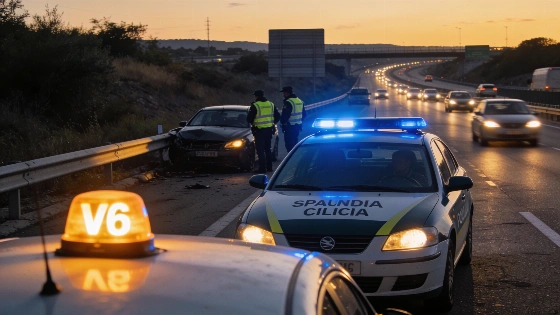
Spain’s Guardia Civil traffic division says it cannot respond to every V16 beacon alert, with daily activations now reaching 2,700. The DGT’s plan to send patrols to each incident is hampered by limited personnel and competing priorities on the roads.
When a driver activates a V16 emergency beacon on a Spanish road, the signal is meant to trigger a rapid response. But according to Carlos Cantero, national traffic coordinator for the Asociación Unificada de Guardias Civiles (AUGC), the reality is far more complicated: Spain’s current traffic police force simply cannot keep up with the volume of alerts.
The Dirección General de Tráfico (DGT) is preparing a new protocol that would formalize the dispatch of the nearest available Guardia Civil patrol to any vehicle that activates a connected V16 beacon. The measure, expected to roll out this summer, aims to standardize a practice that already happens informally—when officers are nearby and not tied up with higher-priority incidents.
Staffing Shortfall
Yet the numbers tell a stark story. The DGT’s digital platform, DGT 3.0, now receives around 2,700 V16 activations every day—about 81,000 per month. Each alert signals a vehicle immobilized on the road, but the system cannot distinguish between a breakdown, a minor accident, or a more serious emergency.
Cantero calls it “materially impossible” for the current force to respond to every alert. The AUGC estimates the Guardia Civil’s traffic division has about 9,000 officers—just 83% of the 10,445 considered necessary. Not all are on patrol at any given time, with shifts, rest days, vacations, sick leave, and administrative duties further reducing the number of available agents in each region.
Competing Priorities
Traffic patrols already face a demanding workload: serious accidents, breakdowns, pedestrian incidents, road hazards, and routine controls for alcohol and drugs. Each operation can require multiple officers and often overlaps with other urgent calls. Cantero points to the A-4 motorway near Madrid, where three or four alerts can come in during a single shift—while only two or three patrols are available to cover the entire stretch.
Adding every V16 activation to their responsibilities would force officers to triage incidents, inevitably leaving some calls unanswered. Cantero also notes that the situation in the Basque Country, where a similar system operates, cannot be directly replicated nationwide due to differences in road networks and officer distribution.
Limits of the V16 Beacon
From January 1, 2026, the connected V16 beacon will be the only legal device for marking immobilized vehicles on Spanish roads. When activated, it transmits the vehicle’s location to DGT 3.0, allowing the incident to be displayed on traffic panels, navigation systems, and apps. However, the beacon does not automatically alert emergency services or specify the nature of the problem.
The DGT itself clarifies that activating the beacon is not a substitute for calling 112 in case of injury or danger. Drivers are still responsible for contacting emergency services or roadside assistance as needed. The beacon’s main function is to improve visibility and information flow, not to guarantee a police response to every incident.
Context and Outlook
Spain’s push to modernize roadside safety with connected technology reflects a broader European trend, but the challenge of matching digital alerts with real-world resources remains unresolved. As the DGT’s new protocol takes effect, the gap between policy and practical capacity will likely shape how drivers experience roadside emergencies—and how authorities prioritize limited patrols.