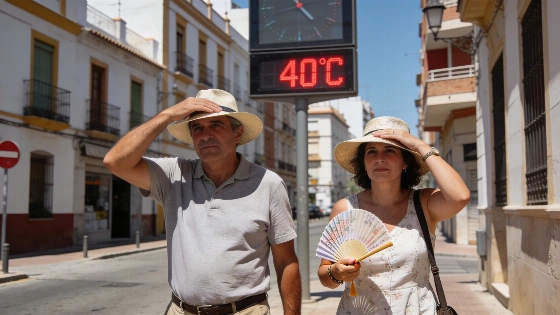
Spain faces a new round of weather alerts as Aemet issues orange and yellow warnings for extreme heat. Regions like Andalusia and Catalonia are preparing for unusually high temperatures, with authorities also monitoring coastal and wind-related risks.
Spain is under widespread heat alerts, with the Agencia Estatal de Meteorología (Aemet) issuing orange warnings for Andalusia and Catalonia as temperatures are set to exceed seasonal norms. The warnings come ahead of a heat surge expected on September 6, raising concerns about health risks and added pressure on emergency services and coastal operations.
Ten other autonomous communities—Aragón, Castilla y León, Castilla-La Mancha, Extremadura, Madrid, Navarra, País Vasco, La Rioja, Comunidad Valenciana, and the Balearic Islands—are under yellow warnings for high temperatures. Catalonia, while under an orange alert, will also see periods of yellow status, showing how uneven but widespread the heatwave is.
On September 4, AEMET recorded 45.7°C in El Granado (Extremadura), matching Spain's all-time September heat record.
Forecasts show the most severe heat will hit the south and northeast, as well as the islands. The Guadalquivir basin could reach 40°C, and large parts of the south and northeast are expected to top 35°C. In some areas of Andalusia, Castilla-La Mancha, and Extremadura, AEMET expects temperatures of 42–43°C or higher, making this heatwave especially intense.
Other risks are also in play. Andalusia remains under yellow alert for dangerous coastal conditions, while the Canary Islands are preparing for strong trade winds and Saharan dust (calima). Aemet has also warned of possible intense storms in the Cantabrian area, the upper Ebro, northern Iberian regions, and the eastern part of the northern plateau, adding more uncertainty to the forecast. AEMET stresses that these alerts are preventive, meant to help the public and authorities prepare, and do not automatically mean a state of emergency.
A subtropical air mass will dominate the eastern half and far south of the peninsula, bringing periods of mid and high clouds that should clear as the day goes on. Elsewhere, a DANA (isolated high-level depression) will bring more cloud cover from midday, with scattered showers and storms likely in the northwest and central-northern regions.
Reuters reported that in August, Spain attributed 2,149 deaths to heat, highlighting the growing public health impact of extreme temperatures and increasing scrutiny of current heatwaves.
Morning fog and low clouds are expected along the Galician coast, Ceuta, and Melilla. The Balearic Islands will have mostly clear skies. The Canary Islands will see variable clouds, with a chance of rain or storms at higher elevations.
Despite the daytime heat, maximum temperatures will drop in most areas, especially in western Galicia. However, the Balearic Islands, eastern coast, Cantabrian coast, and southwestern regions will see further increases. Nights will bring little relief: much of the south and northeast will have "tropical nights," with minimum temperatures staying above 25°C in parts of the Canary Islands, Guadalquivir, and Mediterranean coast. AEMET has linked this to health risks, warning that in many inland areas, nighttime temperatures will stay above 20°C, which can worsen health problems, especially for vulnerable groups.
Wind will add to the challenges. The Canary Islands will have very strong trade winds, the Cantabrian coast will get moderate westerlies, and the Strait of Gibraltar will see strong easterly gusts. Elsewhere, light westerly winds will dominate, except along the Mediterranean, where winds will shift from the east and south. Along with the heat, AEMET warns of strong storms, gusty winds, Saharan dust, and dangerous coastal conditions, all of which increase risks for transport, emergency services, and coastal infrastructure.
Recent weather extremes have already set records in Spain. Barcelona recently broke a century-old September heat record, as reported earlier. The current alerts highlight a pattern of more volatile weather, forcing authorities to adapt quickly to changing risks.
Spain’s response to these weather threats is now a test of public readiness and how quickly institutions can act. The Aemet’s alert system shows a country learning to manage not just isolated events but a new reality of overlapping hazards—heat, wind, storms, and coastal dangers. As warnings increase, the real test will be whether local and regional authorities can turn forecasts into action, especially for those most at risk. The next few days will show how well Spain’s systems can handle the pressure of extreme weather, or if more changes are needed.