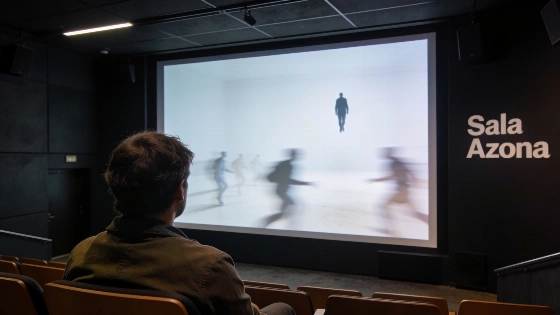
Cineteca Madrid brought two sharply different visions of human isolation to Sala Azcona. Digital fragments and cosmic images made solitude the evening's central subject.
Homo e-sapiens presents human isolation in two radically different forms: a solitary body dancing inside a room and a person suspended against the scale of the universe. Cineteca Madrid brought both visions to Sala Azcona as part of the cycle 'Permanencia de lo efímero', pairing Natalie Bookchin's seven-minute Mass Ornament with Dominic Gagnon's Space Down.
The contrast gives the programme its focus. One film builds its argument from fragmented online video; the other places images of people experiencing isolation and anxiety alongside figures apparently moving through the sky. Together, they shift the question from how individuals behave online to where human beings belong in a much larger and more disorienting space.
Natalie Bookchin’s <em>Mass Ornament</em> was made in 2009 and runs for seven minutes.
Mass Ornament uses a mass remix of internet footage, placing solitary dances and imitative group choreographies in the same visual field. Bookchin, an artist and theorist focused on digital media, treats the online archive as material for a critical reading of society. The official Cineteca Madrid description centres the film on the friction between individual freedom and social control, without relying on a conventional narrative.
Its most forceful image is not a crowd gathered in one place. It is the repetition of private gestures until they begin to resemble collective discipline.
The screening was part of Cineteca Madrid’s official autumn 2026 programme rather than a private or isolated event. The wider Madrid listings from the same week also place Cineteca within a broader seasonal cultural cycle.
Gagnon's Space Down takes the programme in another direction. The available Cineteca and Matadero Madrid listings confirm the film's inclusion in the Homo e-sapiens screening, while the accessible programme materials do not provide a separate independent official profile detailing its production. The film appears alongside Bookchin's work as a meditation on isolation, distance and the unstable place of the human figure.
Those references establish the route behind the film. After looking west, north, south and east, Gagnon turns downward toward the depths of the Earth and outward toward space. Space Down assembles human expressions marked by isolation and anxiety while other people appear to gravitate through the sky. These deliberately improbable perspectives make the human figure look intensely present and almost misplaced.
The screening was scheduled for Wednesday 23 September at 19h in Sala Azcona under the Cine category and the Proyección format. Jobo lists the activity as finalised. Further programme information came from Cineteca Madrid, while the Matadero Madrid card confirms that Mass Ornament and Space Down were the two films announced for the event.
The programme is not built around technological novelty for its own sake. Its subject is the human body after connection has become fragmented, repeated or viewed from an impossible distance. Bookchin finds social control in the circulation of online gestures; Gagnon finds anxiety at the edge of planetary and cosmic scale.
The pairing gives Homo e-sapiens a clear editorial force. It makes digital culture visible as a physical experience of imitation, solitude and disorientation, rather than as an abstract system. The programme works best as a compact confrontation between private movement and collective pressure, not as a simple showcase of experimental video.