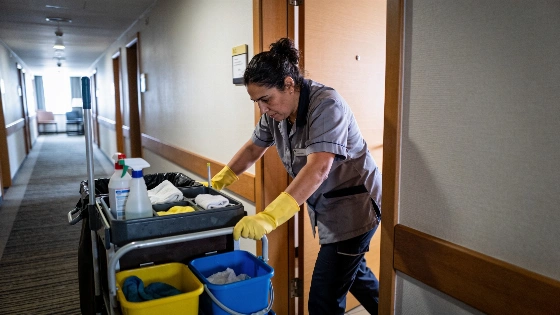
Spanish hotel cleaners face intense pressure, cleaning up to 29 rooms a day for as little as €1.50 per room. Now, unions are formally seeking early retirement options, citing widespread health issues and unsustainable workloads.
Vania Arana, president of the Las Kellys Cataluña union, brought national attention to the plight of hotel cleaners after revealing that some workers are paid as little as €1 to €1.50 per room, with daily quotas reaching up to 29 rooms. Her statements, first aired in a 2019 interview on laSexta, have regained relevance as Spain’s major unions move to secure early retirement rights for this workforce.
During the interview, Arana described a system where failing to meet cleaning targets could result in warnings or dismissal, especially for those employed through outsourcing agencies. One cleaner reported earning just €820 a month, despite the physically demanding nature of the job. Arana, who arrived in Spain from Peru in 1992 and began working in hotels in 1996, has since become a leading voice for labor rights in the hospitality sector. Her activism intensified after a 2014 mass layoff at a Barcelona hotel, which led to a successful legal challenge and the rehiring of dismissed staff.
Health Crisis Among Hotel Cleaners
The physical and mental toll of the job is now backed by data. According to a July 2024 report from CCOO Andalucía, 95.9% of surveyed hotel cleaners reported clinical symptoms of anxiety, 82% suffered from chronic fatigue, and 71.5% regularly used medication for pain or stress. Four in ten showed signs of depression. While these figures are specific to Andalucía, they highlight a broader crisis affecting cleaners across Spain.
CCOO Services reiterated similar findings in July 2026, noting that over 95% of cleaners experience clinical anxiety, 70% live with persistent muscle pain, and 71% rely on medication. The union has called for urgent talks with employers to address workload, health, and the need for early retirement options.
Unions Demand Early Retirement
On July 9, 2026, UGT formally registered a request to initiate the process for early retirement for hotel cleaners, marking the first administrative step toward recognizing the hardship of the profession. However, this registration does not guarantee the right to retire early or set a specific retirement age. Under Royal Decree 402/2025, such requests typically require joint action from unions and employer organizations, though the Ministry can act independently in exceptional cases.
The law demands objective evidence of high rates of temporary or permanent disability and mortality, and requires proof that workplace risks cannot be sufficiently mitigated through improved conditions. If the evaluation is favorable, a new decree would define the eligible occupation and the reduction coefficient. The process must be resolved within six months, and any reduction would count as contributory service for pension calculations. The minimum possible retirement age is 52, but this is not guaranteed for the sector. Both employers and workers would face increased social security contributions if the measure is approved.
Ongoing Battle Over Outsourcing
Las Kellys have long campaigned to ban outsourcing of cleaning services when it is a core hotel activity. Current Spanish law does not prohibit outsourcing, but Article 42 of the Workers’ Statute regulates subcontracting, assigns responsibilities to the main employer, and requires labor information sharing. Typically, the sector’s collective agreement applies, but contractors with their own agreements can sometimes use those instead. Achieving the union’s demands would require legal reform, collective bargaining, or further internalization of cleaning staff.
Workers forced to exceed their contracted hours are advised to keep records such as schedules, payslips, room lists, and company messages. Spanish law requires daily registration of working hours, and labor inspectors accept complaints regarding hours, overtime, pay, and occupational safety. Union support and documentation are crucial for substantiating claims of abuse. Each case depends on the specific contract, applicable agreement, and documented circumstances.
As the debate over early retirement and working conditions continues, the situation of Spain’s hotel cleaners remains a test case for labor rights in the country’s tourism-driven economy. The outcome of the unions’ push for change could set a precedent for other sectors facing similar challenges.