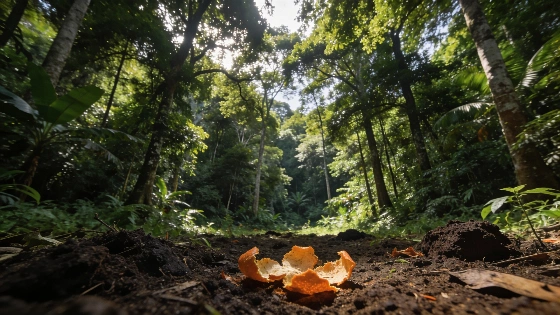
In 1998, 12,000 tons of orange peels were dumped on a barren pasture in Costa Rica. Sixteen years later, scientists found a dense forest where only dry grass once grew, with tree biomass up 176% compared to untreated land.
In 1998, nearly 1,000 truckloads of orange peels and pulp were spread across three hectares of exhausted pasture in Costa Rica’s Área de Conservación Guanacaste. The land, once used for cattle grazing, was left with compacted, rocky soil and dominated by invasive grasses. The goal was simple but ambitious: could industrial fruit waste spark the return of a tropical forest?
The project began a year earlier, when ecologists Daniel Janzen and Winnie Hallwachs brokered a deal between the conservation area and Del Oro, a juice company. In exchange for donating forested land to the reserve, Del Oro was allowed to dispose of its orange processing waste for free on the degraded site. The hope was that the organic matter would restore fertility and suppress the invasive grass, giving native trees a chance to return.
Unexpected Setback
Just as the experiment got underway, a rival company, TicoFruit, filed a complaint alleging environmental harm. The case reached Costa Rica’s Constitutional Court, which ordered an immediate halt to the dumping. With the project frozen, the site was left untouched and unmonitored for over a decade. No further waste was added, and no trees were planted. The orange peels simply decomposed, exposed to the elements.
Transformation Revealed
When researcher Timothy Treuer returned to the site in 2013, he struggled to even locate the original experiment marker. The once-barren field was now dense with vegetation, its dry grass replaced by a closed canopy of trees. In 2014, systematic surveys confirmed the scale of the change: the treated plot had 176% more above-ground woody biomass than a neighboring control pasture. Tree species were more diverse, the soil was richer, and the forest canopy was thicker.
Researchers could not pinpoint a single cause for the dramatic recovery. The orange peels likely provided a surge of organic matter and nutrients, while the thick layer of waste may have choked out the invasive grass, allowing native seeds to take root. The process was not a traditional reforestation—no saplings were planted—but rather an acceleration of natural regeneration, triggered by a one-time intervention.
Lessons and Limits
The Costa Rica experiment stands out among global efforts to repurpose agricultural waste for ecological restoration. However, scientists caution that not all organic residues are suitable for such use. Before repeating this approach elsewhere, it is essential to analyze the waste’s composition, the amount applied, soil conditions, and potential impacts on local species.
As noted in the original study published in Restoration Ecology, the project highlights how partnerships between industry and conservation can reduce restoration costs and address agro-industrial waste. It also underscores the importance of long-term monitoring and control plots to truly measure ecological change.
While the orange peel forest in Costa Rica is a striking example of nature’s resilience, it is not a universal blueprint. Each site and waste stream presents unique risks and opportunities. Still, the transformation of a dead pasture into a thriving forest—using what was once considered garbage—offers a powerful case for creative, evidence-based restoration.