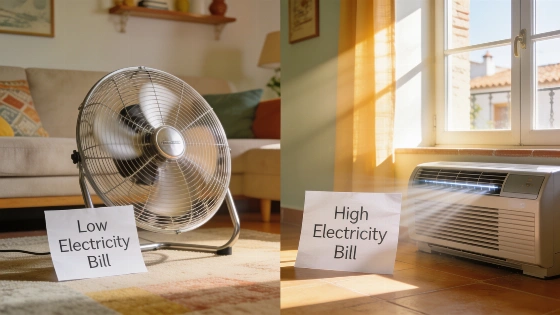
Running air conditioning for eight hours a day can push your electricity bill up by more than €50 a month, while a standard fan keeps costs minimal. Choosing the right appliance can make a significant difference during Spain’s hottest months.
Choosing how to stay cool in summer can have a dramatic impact on your household budget. According to data from Talent24h, running an air conditioner for eight hours a day can increase your electricity bill by more than €50 a month, while a standard fan keeps costs to a fraction of that amount.
The difference comes down to energy consumption. A typical fan uses around 60 watts, while a standard air conditioning unit can draw up to 1,500 watts. Over a month of daily use, this means a fan will consume about 14.4 kWh, costing roughly €2.16 at a reference rate of €0.15 per kWh. In contrast, air conditioning racks up around 360 kWh, translating to €54 for the same period.
Fans: Low Cost, Practical Comfort
Fans remain the most economical way to cool a room during Spain’s hot season. While they don’t lower the actual temperature, they circulate air and create a more comfortable sensation, especially when combined with closed blinds, nighttime ventilation, and proper use of curtains or awnings. For many households, this is enough to manage the heat without a spike in energy costs.
With a fan, even extended daily use barely registers on the monthly bill. This makes it a practical choice for those looking to control expenses, provided the heat is not extreme.
Air Conditioning: Comfort at a Price
Air conditioning offers a clear advantage in comfort by actually reducing indoor temperatures. However, this comes with a much higher energy demand. For households running air conditioning eight hours a day, the monthly cost can exceed €50, a figure that quickly adds up over the course of a long summer.
The difference is stark: air conditioning can use more than 20 times the electricity of a fan. For families with young children, elderly members, or health concerns, air conditioning may be essential, but the financial impact is hard to ignore.
Solar Panels: Reducing the Burden
For homes equipped with solar panels, the cost of running air conditioning during daylight hours can be significantly reduced. Solar production often peaks during the hottest parts of the day, allowing households to offset much of the energy used by cooling systems. This makes air conditioning more affordable for those with sufficient solar capacity.
For most households without solar panels, however, the choice remains clear: fans are the most cost-effective way to stay cool, while air conditioning delivers greater comfort at a much higher price.
As Spain faces another hot summer, understanding the real cost of each option can help families make informed decisions about how to balance comfort and expenses.