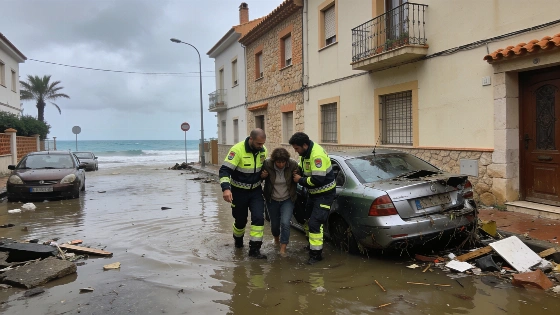
Severe overnight rainfall in Costa Daurada led to mass evacuations and injuries. Authorities faced criticism over the lack of alerts. Key towns in Tarragona province suffered major flooding and damage.
Severe flooding struck the northern Costa Daurada in the early hours of Saturday, catching local authorities and residents off guard. More than 400 people were evacuated and eleven injured, including one child in critical condition, after rainfall far exceeded official forecasts. Emergency services responded to hundreds of calls as water inundated streets, homes, and public spaces across several municipalities in Tarragona province.
The worst-hit areas included El Vendrell, Roda de Berà, Creixell, and Torredembarra, where rainfall reached up to 145.4 litres per square metre in just 24 hours. In El Vendrell, emergency teams had to evacuate a nightclub and assist trapped motorists, while in Roda de Berà, a collapsed wall near the port left a family injured. The force of the water uprooted trees, swept away vehicles, and damaged urban infrastructure, leaving a trail of destruction in its wake.
Despite the scale of the event, no Es-Alert warning was issued to residents’ mobile phones. The Generalitat defended its forecasting, stating that the Servei Meteorològic de Catalunya did not register a sufficient risk level to trigger the alert system at the time. Civil Protection praised the rapid response of local police, firefighters, and emergency medical teams, who carried out dozens of rescues and evacuations throughout the night.
According to Civil Protection, the special flood emergency plan (Inuncat) remains active as authorities continue to monitor the situation and assess when normality can be restored. The orography of the affected areas, with steep torrents and streams flowing directly to the sea, complicated rescue operations and contributed to the rapid accumulation of water. Ongoing construction works intended to improve water flow during heavy rains also posed additional challenges for emergency teams.
Many summer visitors found their vehicles submerged in flooded car parks, while local festivities and summer celebrations were abruptly interrupted by the sudden deluge. In two campgrounds in Roda de Berà and Creixell, nearly 300 people were evacuated as water levels rose unexpectedly. Residents and tourists alike expressed frustration at the lack of advance warning, noting that better information could have prevented some of the damage.
Throughout the night, emergency services received nearly 700 calls to 112, with 200 incidents handled by firefighters and 35 medical interventions by the Servei de Emèrgencies Mèdiques. The mayor of El Vendrell, Kenneth Martínez, highlighted the priority of restoring order and safety now that the immediate risk has passed. Meanwhile, Roda de Berà’s mayor, Pere Virgili, described the destruction of road signs and beaches as unprecedented in his lifetime.
These events follow a pattern of increasingly frequent extreme weather in Spain, as highlighted in recent coverage of rare August storms affecting northern regions. Experts point to climate change as a factor behind the rise in sudden, intense rainfall episodes, which challenge both forecasting systems and emergency preparedness. The Costa Daurada incident underscores the need for improved alert mechanisms and infrastructure adaptation as weather extremes become more common across the country.
Spain’s emergency protocols, such as Inuncat, are designed to coordinate rapid response to flooding, but the effectiveness of public warning systems remains under scrutiny. The lack of timely alerts in this case has prompted debate over how authorities assess risk and communicate with the public during fast-developing weather events. As recovery efforts continue, local governments are expected to review procedures and consider updates to ensure better protection for residents and visitors in future incidents.