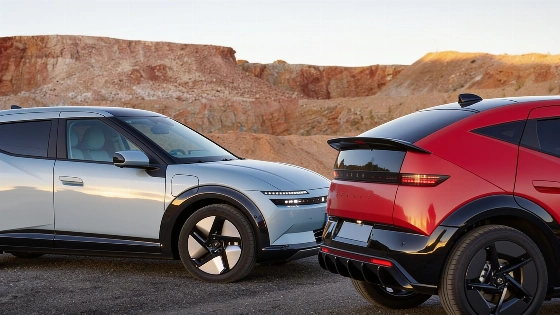
Hyundai has launched the Ioniq 3, a compact electric car built for European cities. With two battery choices and up to 497 km of range, it takes direct aim at Spain’s crowded urban EV market.
Hyundai has jumped into Spain’s city EV fight. The new Ioniq 3 lands with up to 497 kilometers of range and a price tag that undercuts many rivals. This is a direct shot at European brands already holding ground in the segment B electric hatchback space.
The Ioniq 3 measures 4.15 meters long. It rolls out of Hyundai’s İzmit factory in Turkey, built for tight European streets. Buyers get two battery options: a 42.2 kWh lithium iron phosphate (LFP) pack from CATL for the entry model, or a 61 kWh nickel-manganese-cobalt (NMC) battery from Samsung for those who want more distance. The smaller battery is rated for 344 km WLTP. The bigger one stretches to 497 km on a single charge. Hyundai’s official specs and independent reports confirm these WLTP figures: 344 km for Standard Range, up to 496 km for Long Range. Minor differences come down to rounding or early data.
Production of the Ioniq 3 began at Hyundai's İzmit plant in Turkey, making it the first Ioniq-branded electric vehicle specifically developed and manufactured in Europe.
Charging is quick. The Standard Range goes from 10% to 80% in 29 minutes. The Long Range needs just one minute more if conditions are right. Both use a front-mounted electric motor. The Standard Range puts out 107.8 kW (147 CV). The Long Range delivers 99.5 kW (135 CV). Hyundai UK reports the base model gets 214 miles (about 344 km) of range. The 61 kWh version reaches 308 miles (about 496 km), matching WLTP standards.
The Ioniq 3 debuts Hyundai’s new ‘Art of Steel’ design. The car has a low nose and a roofline shaped for space inside, ending in a rear spoiler. Pixel daytime running lights and the Aero Hatch design aim for both good airflow and a roomy cabin. It looks sharp.
Inside, buyers pick between a 12.9-inch or 14.6-inch central touchscreen, depending on trim. All but the base model get a 9.9-inch digital instrument cluster. The boot holds 441 liters, split between the main space and a lower compartment. The Ioniq 3 is the first Hyundai in Europe with the Pleos Connect infotainment system, built on Android Automotive OS. This means smooth smartphone pairing and regular software updates. Hyundai says this is the first time Pleos Connect appears in a European-developed model, with screen sizes set by trim.
The full Spanish lineup includes the Trend trim with a 42.2 kWh battery at €33,895, while the 61 kWh Select starts at €33,995 and reaches €37,895 in Trend. Sportier N Line and N Line Evo versions are priced at €39,995 and €44,795, respectively. In the UK, the base Advance version with a 42 kWh battery is offered at £22,245 before incentives and £18,495 after the Electric Car Grant, with deliveries expected in autumn 2026.
Safety and convenience get attention too. The Ioniq 3 packs 15 driver assist and parking systems. Hyundai set the Spanish starting price at €29,995 before discounts. With Plan Auto+ and a €3,000 IRPF deduction, the entry price can drop to €21,535. That’s a strong offer for buyers watching their budget. Europa Press notes the final price depends on the details of each government program and who qualifies.
Hyundai expects to sell 3,500 to 4,000 Ioniq 3s in Spain in the first full year. Company president Polo Satrústegui says the real number will depend on how much government support is available.
The city EV fight in Spain is heating up. Volkswagen Group has already launched the Cupra Raval, Volkswagen ID. Polo, Skoda Epiq, and Volkswagen ID. Cross, all built in Spain. Renault and Stellantis are pushing the Renault 5 and Peugeot e-208. As reported earlier, new arrivals like the CUPRA Raval Endurance have already shaken up price and performance expectations in this class.
Hyundai’s choice to design the Ioniq 3 in Europe and build it in Turkey shows it knows what local buyers want and where costs matter. The new Pleos Connect system and Art of Steel design are meant to set Hyundai apart on tech and looks, not just price. According to electrive, the Ioniq 3 beats its platform sibling, the Kia EV2, on claimed range: 344 km versus 317 km for standard models, and 496 km versus 448 km for long-range versions.
The Ioniq 3 is more than a gap-filler for Hyundai. It’s a clear play for the top spot in a segment that’s fast becoming the core of Europe’s electric car shift. Range, price, and features all line up to make the Ioniq 3 a real threat to established European brands. Its success will depend on how well Hyundai uses incentives and adapts to changing city mobility needs.