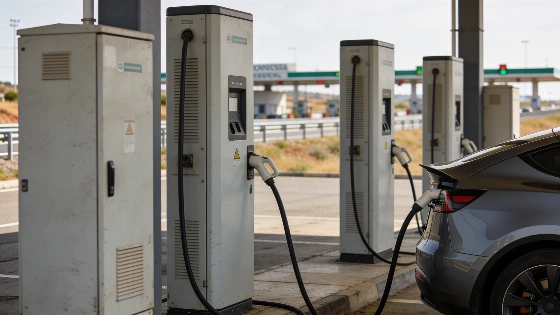
Pablo Pirles says the network is adding about 1,000 points a year and expects to reach 3,000 soon. Its chargers reach 600 kW, while grid delays hold up hundreds of completed sites.
Between 700 and 800 ultrafast charging points are usually complete but still waiting for a grid connection, Pablo Pirles says. The delays can last 12 to 18 months.
That bottleneck has not stopped rapid expansion. Iberdrola BP Pulse began operating on 1 December 2023 and expects to reach 3,000 points in the coming weeks, according to Pirles, its managing director. The company adds about 1,000 a year and aims to maintain that pace. He says it leads the ultrafast charging market in both Spain and Portugal.
For drivers, the size and reliability of each site matter as much as the headline network total. Pirles says the company is adding more chargers to individual stations, making it less likely that drivers will arrive to find every point occupied. Sites can also mix power levels: a car limited to 70 kW need not take a 400 kW charger.
He puts network availability close to 98%, improving year on year. Remote resets reduce the need to send staff to a site. Digital diagnostics can flag equipment delivering less power than it should. The company also works with manufacturers and weighs reliability when selecting chargers.
Equipment across the network ranges from 200 kW to 600 kW. Pirles said a station with 600 kW chargers had recently opened in San Cibrao (Ourense). Few cars on sale in Spain can use that full output today, he acknowledged, but the network is designed to accommodate chargers rated up to 1,000 kW. At many sites, adding power modules can raise capacity without replacing the transformer or cables.
That expansion is expensive. Pirles described the business as highly investment-intensive, with €80 million to €90 million spent each year on building the network, as well as maintaining availability. He also acknowledged that stations are still used well below their designed capacity. That helps explain why the company does not present lower standard tariffs as an immediate fix.
Drivers can pay less through partner loyalty schemes, with discounts of up to 40% against the price shown in the app. Iberdrola customers with a home electricity contract may qualify, as may holders of the company’s no-cost credit card. Separate subscriptions offer discounts of 10% or 20%, depending on the subscription price. For drivers comparing EV ownership costs, including those following the Hyundai IONIQ 3 launch, public charging prices remain part of the calculation.
Storage batteries offer another way to build sites where the grid connection is limited, or an extension would take too long or cost too much. Pirles said a connection of 100 or 200 kW can support charging output of 300 or 400 kW, or several chargers at once. Batteries can also store electricity bought when prices are lower.
Heavy vehicles are already part of the network’s plans. Pirles says more than 200 chargers can serve trucks, although some were not originally designed for them. In 2024, Iberdrola BP Pulse installed a public MCS (Megawatt Charging System) station in Murcia with a refrigerated transport operator. He said the next step is to open Portugal’s first MCS site.