A confidential police report links Moroccan security forces to the mass entry at Ceuta’s border. The Interior Ministry’s efforts to downplay the findings have drawn criticism and raised questions about Spain’s border policy and political credibility.
Spain’s Interior Ministry is facing criticism after a confidential police report contradicted its public statements about the Ceuta border crisis, revealing a gap between official messaging and law enforcement findings. The Ministry’s recent attempt to dismiss suspicions of Moroccan involvement in the July border surge has instead fueled doubts about the government’s transparency and control over the situation.
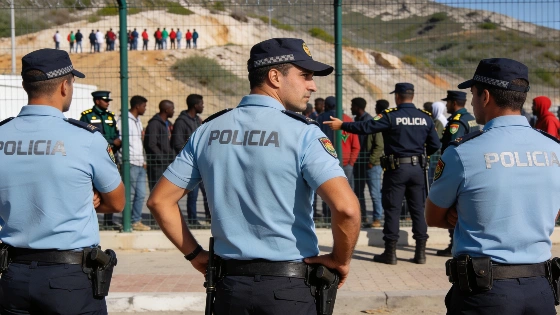
The police dossier, submitted to National Court judge María Tardón, describes a well-organized operation behind the mass entry into Ceuta on July 30 and 31. Contrary to the Ministry’s denials, the 55-page report details "active guidance" by Moroccan gendarmes and points to a level of planning beyond what local criminal groups could manage. According to the report, uniformed Moroccan officers were seen directing migrants along key routes and helping move large vehicles packed with people toward the Spanish border.
According to recent reports by Reuters and Euronews, the number of people who entered Ceuta during the July 30–31 incident exceeded 70,000, with some sources citing figures as high as 80,000.
Investigators also noted the presence of non-uniformed men—aged 30 to 50, athletic, with short hair and neutral clothing—who stood out from the crowd. Some wore caps with police insignia and were seen organizing the flow, giving instructions, and staying in constant communication, suggesting a command structure within the migrant groups. Their actions, including moving against the flow and recording the event, reinforced suspicions that the incident was coordinated rather than spontaneous.
The police analysis rejects the idea that criminal mafias alone could have orchestrated such a large-scale breach. Instead, it describes a dual strategy: using migration as a cover for a calculated attempt to overwhelm Spanish border management and disrupt the state’s response. The report connects the July incident to previous mass entries in May 2021 and September 2024, suggesting a pattern of "grey zone" tactics—measures meant to destabilize without direct confrontation.
One major consequence, according to police, is the damage to Spain’s intelligence services, especially the CNI, whose ability to detect and prevent such operations is now in question. The fallout includes overloaded local services, economic strain, and reputational harm for Spain internationally. The episode has also triggered political instability and exposed weaknesses in coordination between state agencies.
Le Monde, citing AFP, reports that the CENIF police dossier described a 'total permissiveness' of Moroccan forces during the incident, with little effort to push people back from the border and migrant testimonies noting a much lower police presence than usual at crossing points. This aligns with findings from Anadolu and Euronews, which mention both uniformed Moroccan gendarmes and non-uniformed individuals coordinating the flow, though Spain's Interior Ministry publicly disputes that the document directly blames the Moroccan state.
Despite these findings, the Interior Ministry continues to deny any evidence of Moroccan security forces’ involvement, insisting that the police report does not assign responsibility to Morocco. This position has deepened skepticism, especially as the detailed police dossier—reviewed by EL MUNDO—contradicts the Ministry’s claims in several areas. The Ministry’s communication now appears focused on damage control, as previously reported earlier.
With the National Court’s jurisdiction still under review and the prosecution yet to weigh in, the Ceuta incident has become a test for Spain’s border policy and the credibility of its institutions. The Interior Ministry’s insistence on a sanitized narrative, despite mounting evidence, points to a government more concerned with appearances than with addressing the realities at its borders. The episode highlights the fragility of Spain’s migration management and the political cost of prioritizing narrative over fact—a risk that could further erode public trust in the state’s ability to protect its borders.