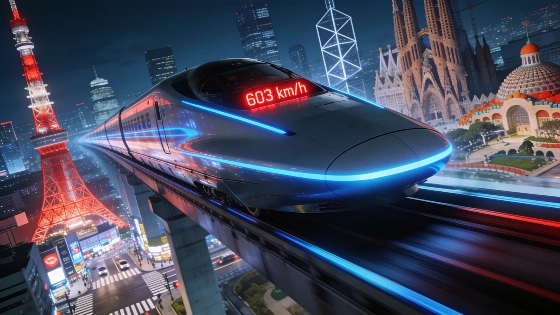
Japan’s Maglev train has set a new speed record, sparking debate about the future of high-speed rail in Europe. If applied in Spain, this technology could cut the Madrid–Barcelona journey to just over an hour, but major obstacles remain.
When Japan’s Maglev train reached a staggering 603 km/h on the Yamanashi test track, it didn’t just break a world record—it reignited the global conversation about what high-speed rail could become. The L0 Series prototype, developed by JR Central, has demonstrated that magnetic levitation is not just a technological showcase but a potential game-changer for national transport networks.
Unlike conventional trains, the Maglev glides above its track, lifted by superconducting magnets that eliminate friction between wheels and rails. As the train accelerates, it rises about 10 centimeters, allowing for smoother, quieter, and dramatically faster travel. Propulsion is achieved through a series of magnetic coils embedded in the guideway, which both pull and push the train forward, precisely controlling speed and stability. This system forms the backbone of Japan’s upcoming Chuo Shinkansen line, set to connect Tokyo, Nagoya, and Osaka at commercial speeds up to 500 km/h.
For Spain, the implications are striking. The current high-speed AVE service covers the 667 kilometers between Madrid and Barcelona in roughly two and a half hours. If a Maglev line were built to operate at Japanese commercial speeds, the same journey could be completed in as little as 75 to 80 minutes, depending on route design and stops. Such a leap would not only halve travel times but also reshape the country’s internal mobility and economic geography.
However, the path to such transformation is far from straightforward. Spain’s existing AVE infrastructure is incompatible with Maglev technology, which requires entirely new tracks, stations, and support systems engineered for much higher speeds and magnetic guidance. The financial challenge is equally daunting: the Chuo Shinkansen’s Shinagawa–Nagoya segment alone is now projected to cost 11 trillion yen, a figure that has ballooned from earlier estimates. JR Central has clarified that the often-cited 2035 opening date is used for financial modeling, not as an official launch target.
These realities mean that, for now, Japan’s Maglev serves more as a vision of what’s possible than a blueprint ready for export. Its record-breaking performance highlights the technical ceiling of high-speed rail, but also underscores the scale of investment and planning required to bring such systems to life elsewhere. As Spain weighs its own transport future, the Maglev stands as both inspiration and cautionary tale.
Europe’s appetite for ambitious rail projects is growing, as seen in Switzerland’s vast underground tunnel network that is shifting freight from roads to rails—a development explored in detail in this report on Switzerland’s subterranean transport revolution. While the Maglev’s arrival in Spain remains hypothetical, the momentum for reimagining rail is unmistakable.