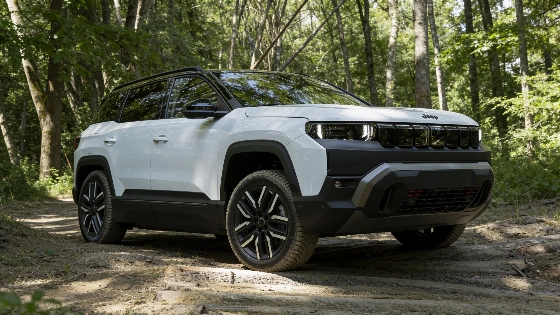
Jeep has unveiled the Compass 4xe, a model that pushes the limits of what an electric SUV can do off the beaten path. Its dual-motor all-wheel-lead system delivers 375 hp, while the usable 96.1 kWh battery is associated with a WLTP combined range exceeding 600 km. That figure comes from a certified test cycle, not a promise of the same range in every driving situation. Speed, terrain, temperature, payload and driving style all affect real-world performance.
At first glance, the exterior remains unmistakably Jeep, with the iconic seven-slot grille now illuminated for a modern touch. The C-segment SUV is based on Stellantis’ STLA Medium platform. It was designed in Turin, developed and tested at Balocco, and is produced at the Melfi plant in Basilicata, Italy. The Compass measures approximately 4,550 mm long, 1,900 mm wide and 1,700 mm high, with a 2,800 mm wheelbase. Aerodynamic improvements give it a drag coefficient of 0.29. Its suspension sits 10 mm higher than standard, improving ground clearance and off-road geometry. The vehicle has a 28° approach angle, a 17° breakover angle and a 31° departure angle, with a wading depth of up to 480 mm.
Durability is a clear priority. The new modular bumper, made from molded black material, is built to withstand impacts and scratches during off-road excursions, reinforcing the Compass’s rugged image. The Upland trim comes standard with 19-inch wheels, a rear tow hook, fog lights and roof rails. The Overland version adds diamond-cut 19-inch wheels, a backlit grille with Matrix LED headlights, a matte-black front fascia and tinted rear windows.
Inside, the Compass 4xe uses more resilient materials and seat upholstery designed to last. The rear cargo area has a scratch-resistant surface, a practical touch for pet owners and frequent travelers. Technology is front and center, with a 10.25-inch digital instrument cluster and a 16-inch touchscreen infotainment system. Both support wireless smartphone connectivity.
Higher trims add a 360-degree camera, wireless phone charging and a broad suite of driver-assistance features, including predictive adaptive cruise control, active lane keeping and rear cross-traffic alert. One useful detail is the physical lead-mode selector on the center console. It allows quick, intuitive changes without taking eyes off the road, a practical touch that sets it apart from many rivals.
Rear-seat space and the 515-liter boot are somewhat limited, which may be a drawback for families or anyone needing maximum cargo capacity. Even so, the overall package remains compelling for buyers who prioritize capability and innovation.
On and Off the Road
Testing the Compass 4xe revealed its dual character. On paved roads, Sport mode delivers the smooth, responsive feel expected from a modern electric vehicle, with confident handling through corners. The real test came on challenging off-road tracks, where it tackled uneven terrain, water crossings and sandy paths with ease. Switching to Sand mode noticeably increased grip, while the steering provided clear feedback and confirmed the vehicle’s stability in demanding conditions. Separate electric motors on the front and rear axles provide all-wheel lead, without a conventional mechanical driveshaft. The powertrain responds immediately and electronically distributes lead between the axles, helping the Compass handle rocks, slopes and loose surfaces.
The reported 28° approach angle, 31° departure angle and 480 mm wading depth give the Compass 4xe useful off-road dimensions, but those figures alone do not establish its suitability for extreme terrain. The dual-motor system and selectable terrain modes are intended for tracks, snow and moderate off-road use. The architecture has no conventional differential locks or low-range gearing for prolonged, severe conditions.
Powertrains and Pricing
The Compass 4xe is the most powerful version in the lineup. Its 157 kW front motor and 132 kW rear motor combine to deliver 375 hp and all-wheel lead. The rear lead unit uses a Jeep-specific motor. Its quoted maximum of 3,100 Nm refers to torque at the rear wheels after reduction gearing, not motor-shaft torque. The usable 96.1 kWh battery supports a WLTP combined range exceeding 600 km. DC charging from 20% to 80% takes about 27 minutes.
The broader Compass range includes a 145 hp e-Hybrid, a plug-in hybrid and a 213 hp fully electric variant with up to 500 km of range. A BEV Long Range model offers 231 hp and up to 674 km on a single charge. It is listed with a 96.3 kWh battery and supports rapid charging, recovering 60% of its capacity in under half an hour. In an Autofans road test, the Compass recorded consumption of around 18 kWh/100 km. The review found that practical range was substantially below the WLTP figure, underscoring the gap between a test-cycle rating and everyday driving.
Pricing in Spain starts at €43,200 for the e-Hybrid Altitude. The plug-in hybrid begins at €46,600, while the 213 hp electric version starts at €50,600. The BEV Long Range is priced from €53,850. The flagship Full Electric 4xe, with 375 hp and all-wheel lead, starts at €56,850 in Upland trim and reaches €60,350 for the Overland.
Context and Outlook
The Compass 4xe enters a competitive segment where electrification and off-road capability rarely intersect. Jeep’s 4xe badge has traditionally identified plug-in-hybrid four-wheel-lead models. On this generation, it denotes a fully electric, dual-motor all-wheel-lead layout. While many compact SUVs focus on efficiency or comfort, Jeep combines electric driving with off-road features. Traditional gasoline and diesel SUVs remain appealing to some drivers, as noted in this recent overview of top compact SUVs under €50,000. The Compass 4xe shows how electric powertrains can pair long-distance capability with rugged-SUV functionality, although actual range depends on conditions and use.
As Spain and Europe accelerate the shift toward electrification, models like the Compass 4xe point to a future in which adventure and sustainability can coexist. For buyers seeking a capable, future-ready SUV, Jeep’s latest offering sets a new benchmark in the segment.