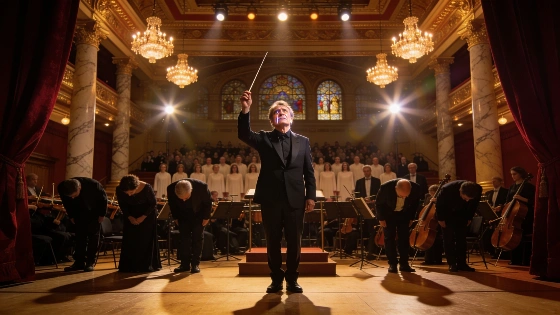
Josep Pons steps down after 14 years as music director at the Gran Teatre del Liceu. His tenure brought new talent and a stronger artistic identity to the orchestra and choir. The transition marks a significant moment for Barcelona's cultural scene.
After 14 years at the helm of the Gran Teatre del Liceu's music direction, Josep Pons is concluding a transformative era for one of Barcelona's most prominent cultural institutions. Pons, who took over in 2012, emphasized during his farewell press conference that the original vision for the orchestra and choir has been realized in full detail. His leadership has been marked by a deliberate effort to bring the Orquestra and Cor del Liceu to the center of the theatre's artistic life, moving them away from a peripheral role and making them a driving force in the institution's programming.
Under Pons, the orchestra has seen the addition of 41 new musicians, while the choir, led by Pablo Assante, has welcomed 30 new voices. This renewal has attracted a wave of young talent, with Pons noting that the Liceu has become a sought-after destination for emerging musicians. He described the orchestra as healthy and deeply committed, highlighting the sense of unity and dedication that has become its hallmark. Pons also pointed out that his approach has focused more on laying foundations for the future than on immediate results, a philosophy he previously applied at the Orquesta y Coro Nacionales de España.
The final concert of his tenure, scheduled for July 24, will feature Gustav Mahler's Symphony No. 8, a monumental work that Pons regards as the culmination of his symphonic journey with the composer. The performance will bring together the Orquestra and Cor del Liceu, the Coro Nacional de España, the Polifònica de Puig-reig, and the Cor Vivaldi, alongside a distinguished vocal cast including Michael Spyres, Elisabeth Teige, Nicholas Brownlee, and Albert Dohmen. This event is set to be a highlight of the season and a fitting close to Pons's directorship.
During the farewell event, Liceu board president Salvador Alemany, general director Valentí Oviedo, and music director Víctor Garcia de Gomar all praised Pons's impact. Alemany underscored the lasting legacy and transformation Pons brought to the orchestra, while Oviedo described him as a humanist and a wise companion to the theatre, noting his deep connection to Barcelona and Catalonia. Garcia de Gomar credited Pons with forging a unique sonic identity for the Liceu, steering clear of grandiosity and focusing on a shared musical experience with both the audience and the institution. Assante, who leads the choir, called the collaboration with Pons enriching for all involved.
Throughout his time as music director, Pons has conducted 84 different titles and nearly 360 performances, drawing close to 550,000 spectators and maintaining an average occupancy rate of 83%. His work and influence at the Liceu will be documented in a film by Igor Cortadellas, which will offer an intimate look at Pons's preparation for Mahler's Symphony No. 8. In addition, a book by Jesús Ruiz Mantilla, to be published by Galaxia Gutenberg, will chronicle these 14 years and Pons's relationship with Barcelona, with both projects set for release in autumn 2027.
The transition at the Liceu comes at a time when the Spanish cultural scene is seeing renewed attention to leadership changes and their impact on major institutions. This shift echoes broader discussions in the arts sector, similar to the debates that have arisen in other high-profile settings, such as the recent on-air incident involving Marta Gómez Montero and Jesús Cintora, which highlighted the intensity of public roles in Spain's cultural life. For more on the dynamics of such transitions, see this report on a recent televised debate: unexpected developments on 'Malas lenguas noche'.
The conclusion of Pons's tenure marks a significant chapter for the Gran Teatre del Liceu. As he moves into the role of honorary music director, the institution prepares for a new phase, building on the foundations he established and the artistic momentum generated over more than a decade of leadership.
The Gran Teatre del Liceu, founded in 1847, is one of Europe's leading opera houses and a central pillar of Barcelona's cultural identity. Its orchestra and choir play a vital role in the city's musical landscape, and leadership transitions at this level often signal broader shifts in artistic direction and institutional priorities. The upcoming projects documenting Pons's legacy are expected to provide valuable insights into the evolution of the Liceu and its place in Spanish and European culture.