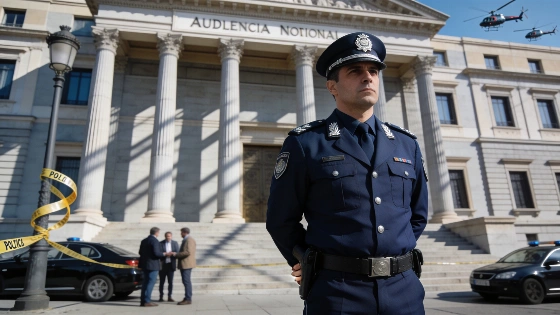
The National Court has decided that Antonio Balas will continue leading the 'caso Koldo' investigation, even after his promotion. This move, backed by Anticorrupción, keeps him at the center of several sensitive probes.
The National Court has ruled that Antonio Balas, recently promoted to lieutenant colonel, will remain in his current post at the Unidad Central Operativa (UCO) to continue leading the high-profile 'caso Koldo' investigation. The decision, initiated by Anticorrupción prosecutor Luis Pastor and endorsed by Judge Ismael Moreno, was formally communicated to UCO chief Pedro Merino Castro. This ensures Balas stays at the helm of the probe, despite his career advancement, at a critical moment for ongoing judicial inquiries involving political corruption.
According to the official request from Anticorrupción, Balas's role as one of the main investigators in the DP 65/23 case and his significant contribution to the process made his continued presence essential. The document cited Article 16 of Royal Decree 769/1987, which stipulates that officers assigned to judicial police units cannot be removed from specific investigations without judicial or prosecutorial approval, unless legally required. The request asked the UCO command to take all necessary steps to guarantee Balas's continuity until the investigation concludes.
Judge Moreno has now formally relayed this directive to the UCO, aligning with Anticorrupción's position. While the measure is currently limited to the 'caso Koldo', Balas's ongoing assignment is expected to extend his involvement in other sensitive cases, including the 'caso Cloacas del PSOE', a separate line of inquiry into alleged corruption within SEPI linked to Leire Díez. The investigation has revealed that Díez considered Balas a key adversary, reportedly targeting him as the main figure behind probes affecting the PSOE and the government. In one meeting, she allegedly expressed a desire to see Balas removed, as she sought information against the UCO, Anticorrupción, and the judiciary.
The UCO, under Balas's leadership, has also been responsible for investigating the brother of the Prime Minister, a case now awaiting a verdict. The legal framework invoked by the prosecution and the judge is clear: officers assigned to judicial police units must remain on their designated cases until the investigation or its procedural phase ends, unless a competent judge or prosecutor decides otherwise. Any mandatory transfer or removal must be reported to the judicial authority for review.
This development comes as scrutiny intensifies over political corruption cases in Spain. The 'caso Koldo' is one of several ongoing investigations with potential implications for the current government and the PSOE. The decision to keep Balas in place is seen as a move to maintain continuity and expertise in complex cases. For further context on the broader network of related scandals, including the SEPI and Leire Díez cases, see this report on how María Jesús Montero has responded to the expanding probe: PSOE official distances herself from SEPI scandal.
Spain's judicial police units, such as the UCO, play a central role in investigating high-level corruption and organized crime. Their independence and continuity are considered vital for the integrity of major cases. The legal protections for officers like Balas are designed to prevent disruptions that could undermine sensitive investigations. As these cases progress, the stability of investigative teams remains a key concern for both the judiciary and the public.