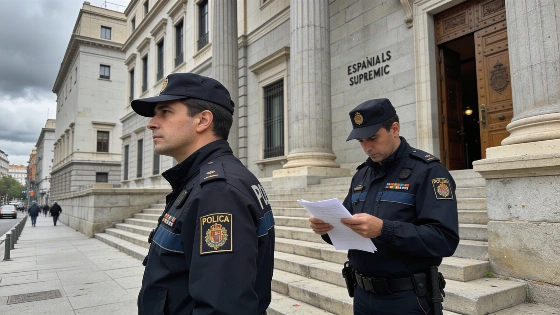
Spain’s Supreme Court has denied amnesty to Carles Puigdemont on malversación charges. Judge Pablo Llarena says the arrest warrant remains in force. The Constitutional Court will have the final say.
Spain’s Supreme Court has again denied amnesty to Carles Puigdemont, leaving the arrest warrant against the former Catalan president in place. Judge Pablo Llarena rejected applying the amnesty law to the malversación charges, arguing that the case involves personal financial benefit. The decision leaves Puigdemont’s legal situation unchanged despite political pressure and recent European court rulings. ARA and EFE report that personal benefit is Llarena’s basic reason for excluding the case from amnesty.
Puigdemont’s defense cited a recent ruling from the European Court of Justice (TJUE), which found no conflict between the Spanish amnesty law and EU law, to support its request for amnesty. Llarena disagreed: he said the European court addressed only the impact on EU financial interests, not personal enrichment. He maintains that using public funds for the independence process puts the case outside the amnesty law’s scope. EFE reports that the Supreme Court’s position has not shifted despite the new European context.
The Constitutional Court is scheduled to begin reviewing the first amnesty appeals on September 22, 2026, with Jordi Turull’s case set as the initial test.
In his ruling, Llarena acknowledged that the TJUE decision removes the argument about EU financial interests, but maintained that personal benefit remains at issue. He argues that using public money for the independence push amounts to financial gain for those involved, which the amnesty law does not cover. Llarena also noted that the Constitutional Court’s recent support for the amnesty law does not settle the Supreme Court’s interpretation of personal benefit. That question remains unresolved. ARA and EFE report that the debate now turns on constitutional and criminal law interpretation in Spain.
Puigdemont’s lawyers also asked for the arrest warrant to be lifted. They argued that the case should be closed or transferred to Catalan courts, and that double jeopardy applies because of parallel proceedings in the Tribunal de Cuentas. Llarena rejected the arguments. He said the case remains open and double jeopardy has not been established, and found that the amnesty law does not apply. He stressed that his decision does not make the measures permanent; they remain in place until circumstances change. ARA reports that legal experts say the Supreme Court could reconsider the arrest order after a clear ruling from the Constitutional Court. For now, the warrant remains active.
Attempts to move the case to the Tribunal Superior de Justicia de Cataluña or Barcelona courts have also failed. Llarena dismissed those requests, along with the claim that Puigdemont is being prosecuted twice for the same acts, citing the ongoing financial investigation in the Tribunal de Cuentas involving more than thirty former Catalan officials.
The Tribunal de Cuentas has announced plans to apply amnesty to 35 individuals involved in the 'procés' spending cases, following the TJUE’s clarification that EU funds were not affected. The move signals that Spanish judicial bodies are taking different approaches to the scope of the amnesty law.
La Voz de Galicia
The legal standoff comes amid continued political tension in Spain over the unresolved Catalan issue. The Supreme Court’s stance contrasts with the government’s push for reconciliation and the Constitutional Court’s recent support for the amnesty law. The outcome now depends on the Constitutional Court’s review of appeals from people convicted or charged in the “procés” case. As in other high-profile cases, including the government’s handling of the Ceuta border crisis, judicial decisions continue to shape Spain’s political reality beyond the courtroom.
The Supreme Court’s refusal to grant amnesty to Puigdemont reflects the ongoing conflict between Spain’s judiciary and political institutions. By focusing on personal financial benefit, Llarena has set a high bar for future amnesty applications related to malversación. Puigdemont remains in legal limbo, with the courts showing no sign of yielding to political or external pressure. The question of amnesty for the “procés” remains in the hands of the courts, not politicians.