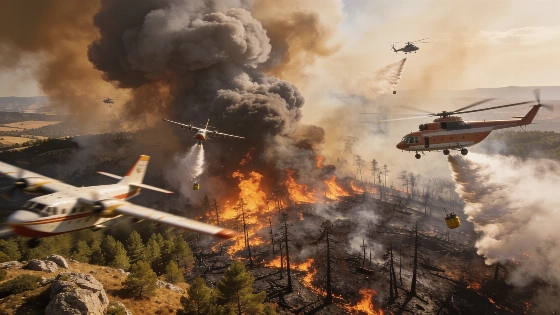
A cluster of fast-moving wildfires has scorched more than 72,000 hectares in Spain in just two weeks. The scale and speed of these blazes make this July one of the most severe periods since 1983. Emergency resources are stretched as authorities battle multiple fronts.
Spain is facing one of its most intense wildfire episodes in decades, as more than 72,000 hectares have burned in just two weeks this July. Unlike previous years marked by numerous scattered fires, this surge is driven by a handful of massive, fast-moving blazes concentrated in central regions. The most significant outbreaks erupted between Thursday and Friday across Almorox (Toledo), Burgohondo (Ávila), and the Madrid municipalities of San Martín de Valdeiglesias and Villa del Prado—areas all within 40 kilometers of each other.
The fire in Burgohondo alone consumed 8,000 hectares in under 48 hours, nearly merging with neighboring fronts. These simultaneous fires have been fueled by extreme heat, low humidity, and strong winds, creating conditions for aggressive expansion. According to Ferran Dalmau, a forestry engineer, such proximity means fires interact rather than compete, complicating containment as resources must be divided among multiple emergencies.
Another major blaze, in La Mierla (Guadalajara), was stabilized five days ago but spread so rapidly and over such a vast area that it is expected to rank among Spain’s largest recorded wildfires. Preliminary data suggest it burned around 35,000 hectares, including 20,000 hectares of the Sierra Norte de Guadalajara Natural Park, and stretched over 40 kilometers. This event alone has significantly raised the year’s total burned area.
Between July 9 and 22, the area affected by large wildfires—those exceeding 500 hectares—has reached levels not seen since 1983, the start of comparable official records. The 72,000 hectares lost in this short period surpass the annual totals of 31 out of the last 43 years. Only a few years, such as 2025, 1994, and 2022, saw similar or greater devastation, often due to either a high number of medium-sized fires or a few exceptionally large ones.
Recent data show a clear trend: while the number of large wildfires has halved over the past four decades, the average size of each has more than doubled. In the 1980s and 1990s, Spain typically saw about 50 large fires per year; from 2010 to 2025, that figure dropped to 26, but each fire now covers a much larger area. Satellite data from the European Copernicus program confirm this shift toward fewer but more explosive and rapidly spreading incidents.
The concentration of fires in a short timeframe puts extraordinary pressure on emergency services. When several major blazes ignite simultaneously, as seen this July, firefighting resources—aircraft, crews, heavy machinery—must be prioritized, often focusing on protecting population centers. The National Civil Protection System is designed to respond when regional capacity is overwhelmed, allowing for state-level intervention and unified command in emergencies of national interest.
July and August remain the most critical months for wildfires in Spain, accounting for 70% of the annual burned area. So far this year, more than 93,000 hectares have been lost to large fires by July 22, nearly four times the historical average for this point in the season. However, the final impact will depend on August’s conditions; in nearly half of the past 43 years, less than 10,000 hectares burned in August, and in seven years, the figure was below 5,000. If major fires are avoided in the coming weeks, the season could still end below record levels.
For context, last year’s wildfire crisis was even more concentrated. In August 2025, a single week saw over 130,000 hectares burn in Ourense alone, with 40 large fires across Ourense, Zamora, and León totaling more than 312,000 hectares. This pattern of clustered, high-intensity fires—now repeating south of Madrid and Ávila—makes containment especially challenging. The situation echoes recent events in Madrid, where a series of wildfires forced mass evacuations and stretched emergency services to their limits, as detailed in this report on the Madrid wildfire crisis.
Official statistics on large wildfires are compiled from the Ministry for Ecological Transition’s General Statistics of Forest Fires (EGIF) for 1983–2022 and the European Forest Fire Information System (EFFIS) for 2023–2026. While both sources generally agree on the number of major incidents, EFFIS tends to report slightly larger affected areas due to its inclusion of non-forest land. Data for 2026 remain provisional, covering events up to July 23. Historical comparisons are limited to post-1983 records, as earlier data lack consistent location details.
Understanding the scale and concentration of these fires is crucial for future prevention and response. The methodology focuses on the worst 14-day period each year, assigning each fire to its start date to track how quickly damage accumulates. This approach highlights the growing challenge posed by fewer but larger and more destructive wildfires in Spain’s changing climate.